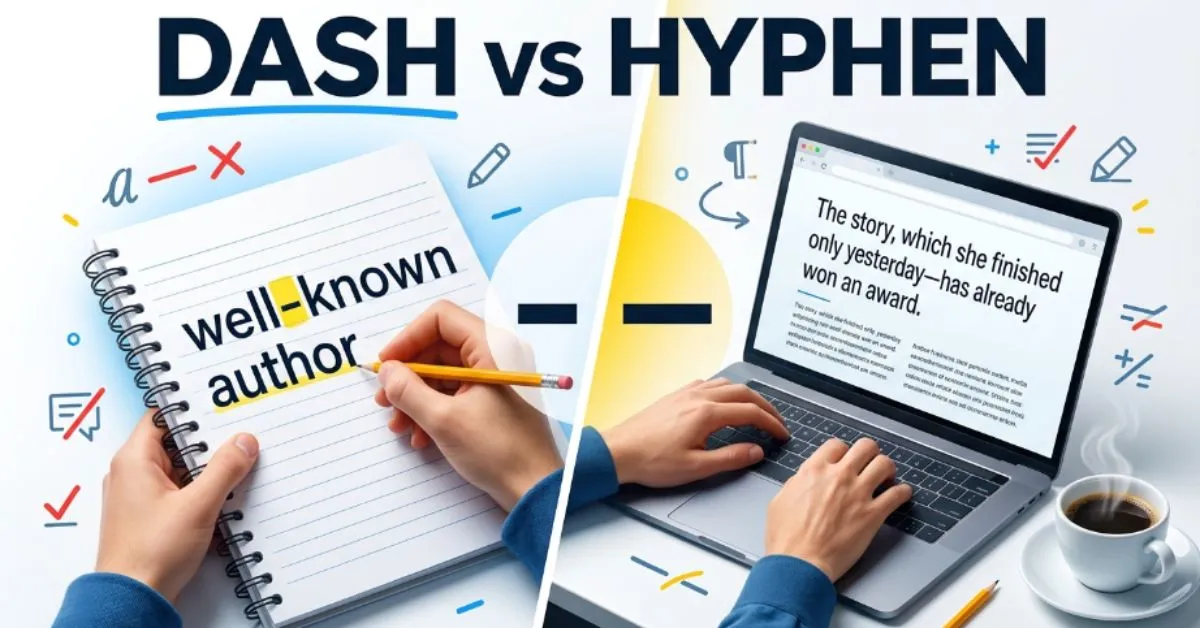
I still remember proofreading an article for a client and feeling completely confident about my punctuation. Everything looked perfect until the editor highlighted several places where I had used a hyphen instead of a dash. At first, I thought they were the same thing. After all, both look like small horizontal lines. How different could they be?
As it turns out, they are very different.
Many writers, students, bloggers, and even professionals confuse dashes and hyphens every day. Since they look similar on a keyboard and often appear in the same types of sentences, it is easy to assume they are interchangeable. Unfortunately, using the wrong one can make your writing look less polished and even change the meaning of a sentence.
The confusion becomes even greater because there are actually different types of dashes, including the en dash and em dash. Meanwhile, the humble hyphen has its own important job in English grammar.
If you have ever wondered whether to use a dash or hyphen, you are not alone. The good news is that learning the difference is much easier than it seems.
In this guide, I’ll explain dash vs hyphen in simple terms, show clear examples, and share easy memory tricks that will help you use them correctly every time.
⚡ Dash or Hyphen Quick Answer
A hyphen ( ) joins words together.
A dash ( or ) separates ideas, shows ranges, or adds extra information.
Quick Examples
- Well known author ✅ (hyphen)
- The meeting starts at 9:00 a.m. please don’t be late. ✅ (dash)
- New York Boston flight ✅ (en dash)
- Well known author ❌
The simple rule: Hyphens connect. Dashes separate.
🤔 Why Do People Confuse Dash or Hyphen?
The confusion usually comes from appearance.
Both punctuation marks are horizontal lines, and many people use the keyboard hyphen for everything because it is easy to type.
Other reasons include:
- Similar appearance
- Limited grammar instruction in school
- Word processors automatically inserting dashes
- Social media encouraging informal writing
- Many writers never learning the difference
Another challenge is that English actually uses three similar symbols:
- Hyphen ( )
- En Dash ( )
- Em Dash ( )
To someone unfamiliar with punctuation rules, they can look nearly identical.
However, each one serves a different purpose.
📜 The Origin of Dash and Hyphen
Understanding their history helps explain why both exist today.
The Origin of the Hyphen
The word hyphen comes from the Greek word huphen, meaning “together.”
Its purpose has always been to connect words.
Examples:
- Mother in law
- Part time
- Well written
The hyphen acts like glue that joins words together.
The Origin of the Dash
The word dash appeared in English during the 16th century.
Printers used dashes to create pauses, interruptions, and dramatic emphasis.
Over time, two main types developed:
En Dash ( )
Named because it is roughly the width of the letter “N.”
Common uses:
- Number ranges
- Dates
- Connections between places
Examples:
- 2020 2025
- New York Chicago route
Em Dash ( )
Named because it is roughly the width of the letter “M.”
Common uses:
- Interruptions
- Extra information
- Strong emphasis
Example:
- She finally arrived the traffic was terrible.
🌍 British vs American English
Both British and American English use dashes and hyphens, but there are some style differences.
| Usage | American English | British English |
| Hyphen | Common | Common |
| En Dash | Common | Common |
| Em Dash | Very common | Less common |
| Spaces Around Em Dash | Usually no spaces | Often spaces |
| Compound Words | Similar rules | Similar rules |
Example
American English:
“She arrived the meeting had already started.”
British English:
“She arrived the meeting had already started.”
Both styles are considered correct depending on the style guide being used.
🎯 Which One Should You Use?
The correct choice depends on your purpose.
Use a Hyphen When:
You are joining words.
Examples:
- Full time job
- Well known speaker
- User friendly website
- Long term plan
Use an En Dash When:
You are showing ranges or connections.
Examples:
- Pages 10 20
- Monday Friday
- Boston Washington train
Use an Em Dash When:
You are adding emphasis or extra information.
Examples:
- The answer was simple practice.
- She finally called me I couldn’t believe it.
Blogging, Freelancing, and SEO Perspective
For online content:
- Hyphens improve readability.
- Dashes improve flow and emphasis.
- Professional writing often uses em dashes.
- SEO is generally unaffected, but readability matters.
Well formatted content creates a better user experience and appears more professional.
❌ Common Mistakes (Avoid These!)
Mistake #1: Using a Hyphen Instead of an Em Dash
❌ The answer was simple practice.
✅ The answer was simple practice.
Mistake #2: Using a Dash to Join Compound Words
❌ Well known actor.
✅ Well known actor.
Mistake #3: Using Hyphens for Number Ranges
❌ 2015 2025
✅ 2015 2025
Mistake #4: Overusing Em Dashes
❌ The meeting was late and everyone was tired.
✅ Use em dashes only when they improve clarity.
📝 Real Life Examples
Emails
“Please review the attached report it includes the latest updates.”
Social Media
“Best vacation ever can’t wait to go back!”
News
“The New York Boston rail corridor remains busy.”
Formal Writing
“The company adopted a long term growth strategy.”
Additional Examples
- She is a well respected teacher.
- The store is open Monday Friday.
- The presentation was excellent everyone agreed.
📊 Quick Comparison Table
| Feature | Hyphen ( ) | En Dash ( ) | Em Dash ( ) |
| Purpose | Connect words | Show ranges | Separate ideas |
| Length | Shortest | Medium | Longest |
| Example | Well known | 10 20 | She arrived late |
| Usage | Compound words | Dates, numbers | Emphasis |
| Frequency | Very common | Common | Common |
| Region | Global | Global | Global |
FAQs ❓
Q. Is a dash the same as a hyphen?
No. A hyphen joins words, while a dash separates ideas or shows ranges.
Q. What is the difference between an en dash and an em dash?
An en dash shows ranges or connections. An em dash adds emphasis or interruptions.
Q. When should I use a hyphen?
Use a hyphen to connect words in compound terms.
Q. Is 10 20 a dash or hyphen?
Technically, it should be written as 10 20 using an en dash.
Q. Are em dashes used in professional writing?
Yes. They are common in books, articles, and journalism.
Q. Do bloggers need to use dashes correctly?
Yes. Proper punctuation improves readability and professionalism.
Q. Can I replace commas with em dashes?
Sometimes. Em dashes often create stronger emphasis.
Q. How can I remember the difference?
Think: Hyphens connect. Dashes direct attention.
Conclusion 🎯
The difference between dash or hyphen may seem small, but it can make a big impact on your writing. I used to think they were interchangeable until I learned that each serves a unique purpose.
A hyphen joins words together. An en dash connects ranges and relationships. An em dash creates pauses, emphasis, and additional information.
Once you understand this simple distinction, choosing the right punctuation becomes much easier.
Remember this easy trick: Hyphens connect; dashes separate.
If you keep that rule in mind, you’ll avoid one of the most common punctuation mistakes in English and instantly make your writing look more professional.
The next time you’re deciding between a dash or hyphen, simply ask yourself: “Am I connecting words or separating ideas?” The answer will point you to the correct choice every time.
Discover More Articles:
- Sembol or Symbol : The Ultimate Guide to Using the Correct English Word🔣
- ADHD or ADD : The Simple Difference Finally Explained📖(2026)
- BA or BS : The Simple College Degree Difference Explained🎓(2026)

I’m Dan Brown, an author behind GrammarGuides.com, where I share simple tips to help people write English clearly and correctly. As a grammar expert, I enjoy explaining tricky words, spelling differences, and common language mistakes in an easy way.