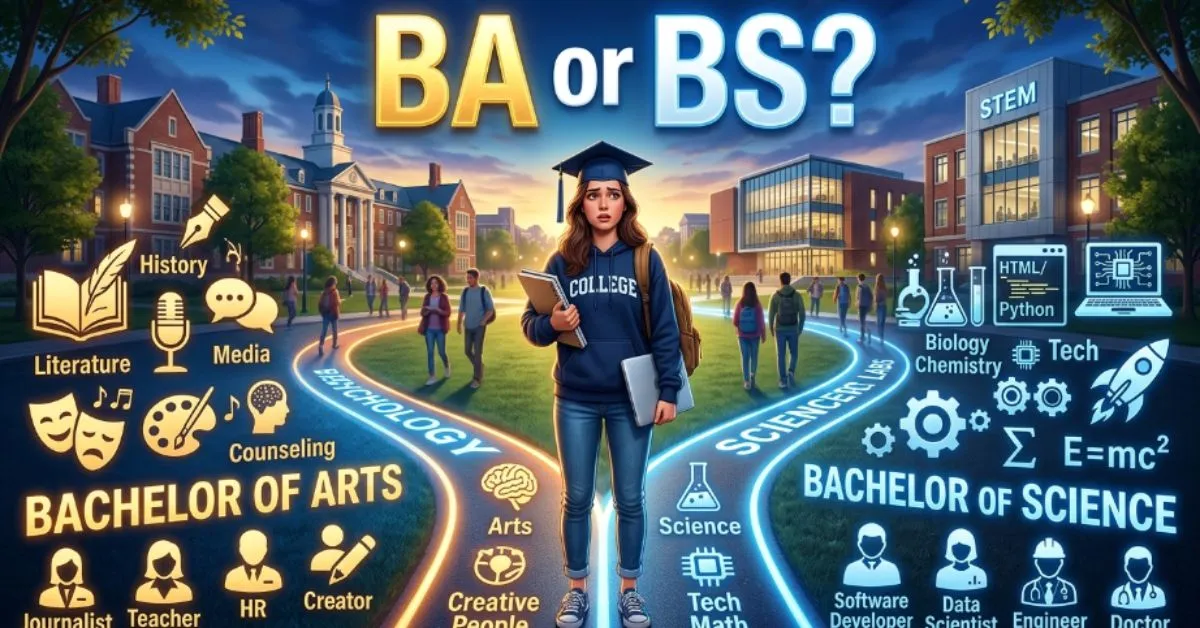
I still remember sitting with my college application open, staring at two degree options: BA and BS. At first, I thought they were almost the same thing. Both were bachelor’s degrees, both took around four years, and both seemed useful. So why were colleges separating them?
That confusion stayed with me for weeks. One friend told me a BS degree was “better.” Another said a BA was easier and more flexible. Then I read online forums where students argued endlessly about which degree employers preferred.
Honestly, the more I searched, the more confused I became.
If you’ve ever wondered “Should I choose a BA or BS?” you are definitely not alone. Thousands of students, parents, freelancers, and job seekers search this question every month. The terms sound simple, but the differences are not always explained clearly.
The good news is that the answer is much easier than most people think. Once you understand what each degree focuses on, choosing between a BA and BS becomes far less stressful.
In this guide, I’ll explain the real difference between BA and BS in simple English so you can make the smartest decision for your future.
⚡ BA or BS – Quick Answer
A BA (Bachelor of Arts) usually focuses more on humanities, communication, and liberal arts subjects.
A BS (Bachelor of Science) usually focuses more on math, science, technology, or technical subjects.
Quick Examples:
- ✅ English degree → often BA
- ✅ Computer Science degree → often BS
- ✅ Psychology can sometimes be BA or BS
Simple Rule:
- BA = broader and flexible
- BS = technical and specialized
🤔 Why Do People Confuse BA or BS?
People confuse BA and BS because both are undergraduate bachelor’s degrees. They usually take the same amount of time to complete and often lead to similar careers.
The confusion becomes bigger because many universities offer the same major in both forms.
For example:
- BA in Psychology
- BS in Psychology
That makes students wonder:
“What’s the actual difference?”
Another reason is that the abbreviations are short and sound equally important. Most schools also explain them differently. One college may focus heavily on science in a BS degree, while another may only add a few extra technical classes.
Social media and online discussions also create myths. Some people claim BS degrees are always better for jobs, while others say BA degrees are easier. In reality, the value depends more on your skills, experience, and career goals.
The names themselves also cause confusion:
- Bachelor of Arts
- Bachelor of Science
People often think “arts” only means painting or music, but BA degrees include many subjects like history, communication, business, and psychology.
📜 The Origin of BA or BS
The history of BA and BS goes back hundreds of years.
BA (Bachelor of Arts)
The BA degree started in European universities during the Middle Ages. It focused on liberal arts education, including:
- philosophy
- literature
- language
- logic
The goal was to create well-rounded thinkers.
BS (Bachelor of Science)
The BS degree became more popular later as science, engineering, and mathematics grew in importance.
Universities created BS programs to focus more on:
- scientific research
- technical training
- mathematics
- laboratory work
Over time, colleges around the world adopted both systems.
Today:
- BA programs often include broader electives
- BS programs usually require more technical coursework
🌍 British vs American English
The terms BA and BS are used differently in some countries.
In the United States:
- BA and BS are both very common.
In the UK:
- BA is more commonly used for many university subjects.
- Some universities use BSc instead of BS.
| Degree | USA | UK | Meaning |
| BA | Common | Common | Bachelor of Arts |
| BS | Common | Less common wording | Bachelor of Science |
| BSc | Rare wording | Very common | Bachelor of Science |
Important Difference
American universities usually write “BS.”
British universities often write “BSc.”
Both mean nearly the same thing.
🎯 Which One Should You Use?
The right choice depends on your goals, interests, and career plans.
Choose a BA If:
- You enjoy writing, communication, or creative subjects
- You want flexibility in coursework
- You plan to study humanities or social sciences
- You may switch careers later
Choose a BS If:
- You enjoy math, science, or technology
- You want technical or research-focused training
- You plan to work in STEM careers
- You prefer specialized coursework
For Bloggers and Freelancers
A BA can help with communication-heavy careers like:
- content writing
- journalism
- marketing
- public relations
A BS can help with technical freelancing like:
- programming
- data analysis
- IT services
For SEO and Career Searches
People often search:
- “BA vs BS”
- “Is a BS better than a BA?”
- “What’s the difference between BA and BS?”
Using both keywords naturally can improve article rankings.
Best Advice
Neither degree is automatically better. The best option is the one that matches your career goals.
❌ Common Mistakes (Avoid These!)
Here are the biggest mistakes students make.
Mistake #1: Thinking BS Is Always Better
❌ “A BS degree is more respected.”
✅ Employers usually care more about skills and experience.
Mistake #2: Assuming BA Means Only Art
❌ “BA is only for artists.”
✅ BA includes many subjects beyond fine arts.
Mistake #3: Ignoring Course Requirements
❌ Choosing based only on the title
✅ Compare the actual classes carefully.
Mistake #4: Forgetting Career Goals
❌ Picking a degree because friends chose it
✅ Choose based on your future plans.
Mistake #5: Confusing BS With Higher Education
❌ “BS is a higher degree than BA.”
✅ Both are bachelor’s degrees at the same level.
📝 Real Life Examples
Here’s how BA or BS appears in everyday situations.
Emails
- “I completed my BA in Communication.”
- “She earned a BS in Computer Science.”
Social Media
- “Trying to decide between a BA or BS in Psychology.”
- “My BS program has so many lab classes!”
News Articles
- “Universities report rising enrollment in BS programs.”
- “BA graduates continue entering diverse industries.”
Formal Writing
- “Applicants must hold a BA or BS degree.”
- “The candidate earned a BS from a state university.”
📊 Quick Comparison Table
| Feature | BA | BS |
| Full Form | Bachelor of Arts | Bachelor of Science |
| Focus | Humanities & liberal arts | Science & technical fields |
| Flexibility | More electives | More specialized |
| Math/Science Classes | Fewer | More |
| Common Careers | Writing, media, education | Tech, science, engineering |
| USA Usage | Very common | Very common |
| UK Version | BA | Often called BSc |
FAQs❓
Q. What is the difference between BA and BS?
A BA focuses more on liberal arts, while a BS focuses more on science and technical subjects.
Q. Is a BS better than a BA?
Not necessarily. The better degree depends on your goals and career path.
Q. Which degree is harder: BA or BS?
BS programs often include more technical coursework, but difficulty depends on the subject and student.
Q. Can the same major have both BA and BS?
Yes. Some universities offer both versions of majors like psychology or economics.
Q. Do employers care about BA vs BS?
Usually, employers care more about skills, experience, and internships.
Q. Is a BA degree respected?
Yes. BA degrees are widely respected and valuable in many careers.
Q. What does BSc mean?
BSc stands for Bachelor of Science, mainly used in the UK and other countries.
Q. Should I choose BA or BS for psychology?
Choose based on your interests. BA may focus more on liberal arts, while BS may include more science and research.
Conclusion 🎯
Understanding BA or BS becomes much easier once you focus on the learning style behind each degree. A BA usually offers broader education and flexibility, while a BS focuses more on technical and scientific training.
Neither degree is automatically smarter, easier, or more valuable. The real difference comes from your interests, strengths, and future goals.
If you enjoy communication, writing, history, or creative thinking, a BA may feel like the better fit. If you enjoy science, math, research, or technology, a BS may match your career path more naturally.
The biggest mistake students make is choosing based on stereotypes instead of looking at actual coursework and career goals.
The next time someone asks whether a BA or BS is better, you’ll know the truth:
- BA = broader learning
- BS = specialized learning
That simple understanding can help you make a much smarter college decision with confidence.
Discover More Articles:
- Peeking or Peaking : Easy Rule + Examples👀(2026)
- Choses or Chooses : The Correct Grammar Explained🤔(2026)
- Occurred or Occured : Here’s the Right Answer✍️(2026)

I’m Veronica Roth, an author at GrammarGuides.com, where I make English easy to understand. As a grammar expert, I help readers master spelling, punctuation, and common language mistakes.