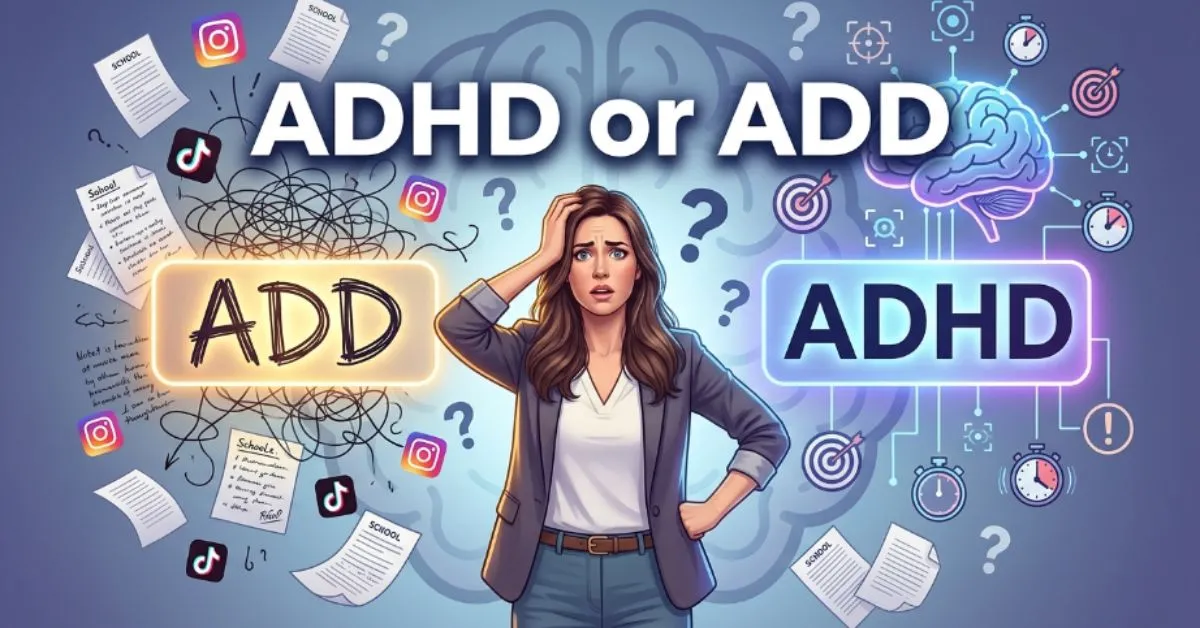
I still remember the first time I heard someone say, “My child has ADD.” A few days later, another person said the same child had ADHD. I honestly thought they were two completely different conditions. That confusion stayed in my mind for years.
Then one day, while reading a health article online, I noticed something strange. Most modern websites, doctors, and schools were using the term ADHD instead of ADD. That made me wonder: Was ADD outdated? Were people using the wrong word? Or did both terms still mean the same thing?
If you have ever searched “ADHD or ADD” and felt confused, you are not alone. Millions of people still mix up these terms every day. Some use ADD in casual talk, while others only say ADHD. This creates misunderstandings in schools, workplaces, parenting discussions, and even online content.
The good news is that the difference is actually very simple once someone explains it clearly. In this guide, I’ll break everything down in easy English so you never confuse ADHD and ADD again.
⚡ ADHD or ADD – Quick Answer
ADD is an old term. Today, doctors officially use the term ADHD for all attention-related conditions.
ADHD stands for “Attention-Deficit/Hyperactivity Disorder.”
ADD used to describe people who had attention problems without hyperactivity.
Quick Examples:
- ✅ Modern medical term: ADHD
- ✅ Older term: ADD
- ✅ “She was diagnosed with ADHD.”
- ⚠️ “ADD” is still used informally by many people.
🤔 Why Do People Confuse ADHD or ADD?
People confuse ADHD and ADD because both terms describe similar behaviors. They both involve trouble focusing, staying organized, or paying attention.
The biggest reason for confusion is history.
Years ago, doctors separated hyperactive behavior from attention problems. People who were easily distracted but not hyperactive were often labeled with ADD. Later, medical experts updated the terminology and placed everything under ADHD.
Another reason is that many adults grew up hearing the word ADD. Parents, teachers, and even TV shows used it for decades. Because of that, the old term still feels normal to many people.
Social media also adds to the confusion. Some creators use ADD casually, while medical professionals usually prefer ADHD.
So even though ADHD is the official modern term, ADD continues to appear in conversations, blogs, and online searches.
📜 The Origin of ADHD or ADD
The history of these terms is interesting.
The word ADD became popular in the 1980s. It stood for “Attention Deficit Disorder.” Doctors used it to describe people who struggled with focus and concentration.
Later, medical experts realized that attention problems and hyperactivity were closely connected. Because of this, they changed the official diagnosis to ADHD.
Today, ADHD includes three main types:
- Predominantly inattentive type
- Predominantly hyperactive-impulsive type
- Combined type
What many people once called ADD is now usually called “ADHD, predominantly inattentive type.”
That means ADD did not exactly disappear. It simply became part of the broader ADHD category.
🌍 British vs American English
Unlike many spelling differences in English, ADHD and ADD are not really a British vs American issue. Both the UK and the USA mainly use ADHD in medical settings today.
However, informal speech may still vary depending on age and region.
| Term | Region | Modern Usage | Notes |
| ADHD | USA | Very common | Official medical term |
| ADHD | UK | Very common | Official medical term |
| ADD | USA | Informal/older | Still used casually |
| ADD | UK | Informal/older | Less common medically |
Key Point:
- Doctors and schools usually prefer ADHD.
- Older adults may still say ADD because that was common in the past.
🎯 Which One Should You Use?
The best term to use today is ADHD.
If you are writing for a USA audience, using ADHD is safer and more accurate. It matches modern medical language and current search trends.
For Bloggers
If you run a blog, you can still mention ADD because many people search for it online. A smart SEO strategy is using both terms naturally.
Example:
- “ADHD (formerly called ADD) affects attention and focus.”
For Freelancers and Writers
Use ADHD in professional work unless a client specifically requests ADD.
For SEO
Many people still type:
- “ADD vs ADHD”
- “What is ADD?”
- “ADD meaning”
Because of that, including both keywords can help your article rank better in search engines.
Simple Rule:
- Professional and modern use → ADHD
- Historical or casual conversation → ADD
❌ Common Mistakes (Avoid These!)
Here are some common errors people make when talking about ADHD or ADD.
Mistake #1: Thinking They Are Totally Different
❌ “ADD and ADHD are separate disorders.”
✅ ADD is now considered part of ADHD.
Mistake #2: Using ADD as the Official Medical Term
❌ “Doctors diagnose ADD today.”
✅ Doctors officially diagnose ADHD.
Mistake #3: Assuming ADHD Always Means Hyperactivity
❌ “Everyone with ADHD is hyperactive.”
✅ Some people mainly struggle with attention and focus.
Mistake #4: Mixing Informal and Medical Language
❌ “My medical report says ADD.”
✅ Modern reports usually say ADHD.
Mistake #5: Ignoring Context
❌ Using ADD in formal health writing without explanation
✅ Mention that ADD is an older term for ADHD.
📝 Real Life Examples
Here’s how ADHD or ADD appears in daily life.
Emails
- “My son was recently diagnosed with ADHD.”
- “Can we discuss ADHD accommodations at school?”
Social Media
- “I thought I had ADD, but my doctor explained it’s actually ADHD.”
- “Living with ADHD can be challenging but manageable.”
News Headlines
- “Experts Raise Awareness About ADHD in Adults”
- “ADHD Diagnoses Continue to Increase Across the USA”
Formal Writing
- “ADHD affects attention, impulse control, and organization.”
- “The patient showed symptoms consistent with ADHD.”
📊 Quick Comparison Table
| Feature | ADD | ADHD |
| Full Form | Attention Deficit Disorder | Attention-Deficit/Hyperactivity Disorder |
| Official Medical Term? | No | Yes |
| Modern Usage | Informal/older | Standard term |
| Includes Hyperactivity? | Usually no | Can include it |
| Used by Doctors Today? | Rarely | Yes |
| SEO Search Popularity | Still high | Very high |
| Common In | Older conversations | Medical and modern use |
FAQs❓
Q. Is ADD the same as ADHD?
ADD is an older name that is now included under ADHD.
Q. Why did doctors stop using ADD?
Medical experts updated the terminology to create one broader diagnosis called ADHD.
Q. Can adults have ADHD?
Yes. Many adults are diagnosed later in life.
Q. Is ADHD always hyperactive?
No. Some people mainly struggle with focus and attention.
Q. Which term is correct today?
ADHD is the official modern term.
Q. Do schools still use ADD?
Some people informally say ADD, but schools usually use ADHD in official documents.
Q. Is ADD outdated?
Yes, medically speaking. However, many people still use it casually.
Q. Should bloggers use both ADHD and ADD?
Yes. Using both terms naturally can improve SEO and reader understanding.
Conclusion
Understanding ADHD or ADD is much easier once you know the history behind the terms. The biggest thing to remember is that ADD is an older label, while ADHD is the official modern diagnosis used today.
Many people still say ADD because they grew up hearing it in schools, conversations, and media. That is completely normal. But in professional writing, medical discussions, and updated educational content, ADHD is the preferred term.
If you are writing articles, creating content, or speaking to a USA audience, using ADHD will usually sound more accurate and current. At the same time, mentioning ADD can still help readers who search for the older term online.
The next time you hear someone say ADD or ADHD, you’ll know exactly what they mean and why both words still exist. That small understanding can help you communicate more clearly, especially in blogging, freelancing, school discussions, and everyday conversations.
One simple tip to remember:
- ADD = older term
- ADHD = modern official term
That’s the easiest way to never confuse them again.
Discover More Articles:
- 🦃 Stuffing or Dressing? : The Easy Trick to Remember the Difference Forever
- Shinning or Shining : Here’s the Correct Spelling Explained Simply✨(2026)
- 🐝 Bee or Wasp : The Easy Identification Trick Everyone Should Know

I’m Franz Kafka, an author at GrammarGuides.com, where I simplify English grammar for readers. As a grammar expert, I guide you through tricky rules and common mistakes.