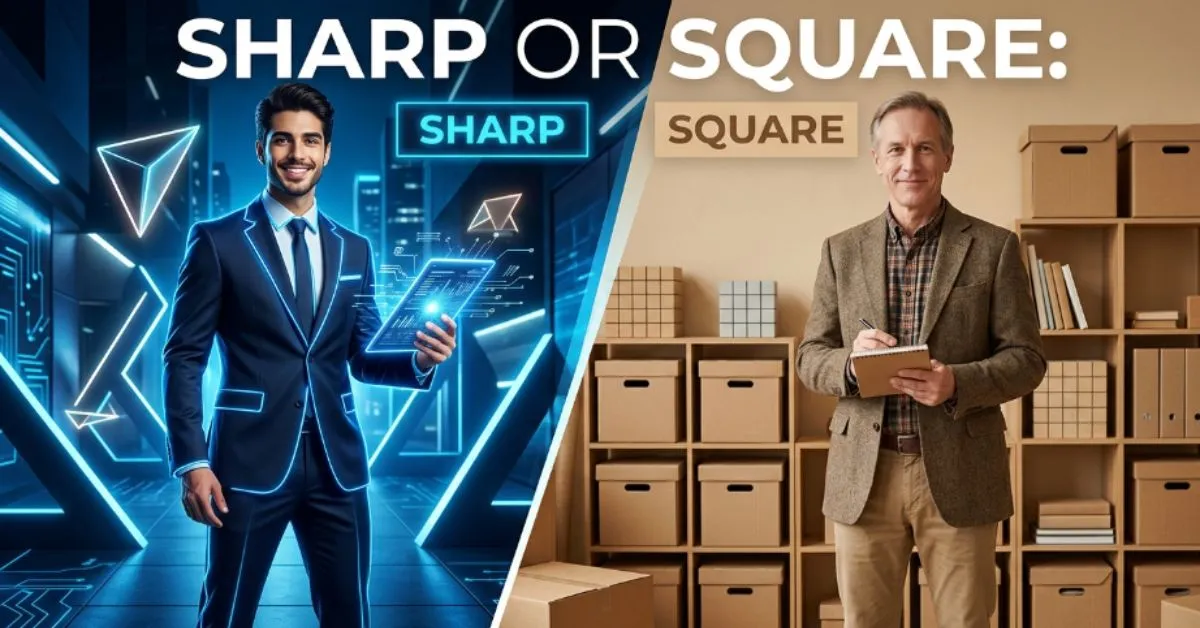
I still remember a moment when I was describing a simple object in a conversation, and I suddenly got stuck between the words “sharp” and “square.” I confidently said something was “square,” but everyone looked a bit confused.
Later, someone corrected me and said I probably meant “sharp.” That small mistake made me realize how easily these two everyday English words can mix up in real communication.
At first, I thought both words were almost the same or just different ways to describe shapes. But when I looked deeper, I understood they carry completely different meanings one often describes intelligence, style, or pointed edges, while the other describes shapes or even traditional thinking.
I decided to handle this confusion by learning real examples and using them in daily life. Slowly, I started noticing the difference naturally in conversations, and it helped me speak more confidently without hesitation.
⚡Sharp vs Square – Quick Answer
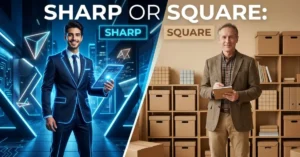
Sharp means intelligent, quick thinking, stylish, or having a pointed edge.
Square means a four sided shape or someone traditional and conventional.
Quick examples:
- She is very sharp in meetings. (smart)
- Be careful, that knife is sharp. (cutting edge)
- The table is square. (shape)
- He is a bit square. (old fashioned)
Simple rule:
Sharp = smart, stylish, pointed
Square = shape or traditional mindset
🤔 Why Do People Compare Sharp and Square?
People compare these two words because:
- Both are used in everyday conversations
- Both can describe people
- Both have literal and figurative meanings
- Both appear in casual English, movies, and slang
The confusion happens because:
- “Sharp” sounds positive and modern
- “Square” sounds simple but sometimes outdated
- Both change meaning depending on context
So learners often assume they are opposites but they are not.
📜 The Background Behind Both Words
Meaning of Sharp
Originally, sharp referred to something with a pointed edge that could cut.
Over time, its meaning expanded:
- Sharp knife → physical edge
- Sharp mind → intelligence
- Sharp outfit → stylish look
- Sharp reply → quick or direct response
Today, “sharp” is mostly positive and widely used in professional English.
Meaning of Square
Square originally described a geometric shape with four equal sides.
Later, it gained slang meanings:
- Square shape → geometry
- Square person → traditional mindset
- “We’re square” → even/settled
Unlike “sharp,” “square” depends heavily on context and tone.
📊 Key Differences at a Glance
| Feature | Sharp | Square |
| Main Meaning | Intelligent / pointed / stylish | Shape or traditional personality |
| Used for People | Yes | Yes |
| Tone | Mostly positive | Neutral or old fashioned |
| Object Use | Cutting edges, tools | Shapes, design |
| Common Use | Very high | Moderate |
| Best For | Intelligence, fashion, precision | Geometry, traditional behavior |
| Example | Sharp mind | Square table |
| Risk of Misuse | Medium | Medium |
🔍 Feature by Feature Comparison
1. Meaning in Daily Life
- Sharp: smart, quick, stylish, or pointed
- Square: shape or conventional thinking
2. Personality Use
- Sharp person = intelligent, alert, fast thinker
- Square person = traditional, rule following, old school
3. Physical Objects
- Sharp = knives, scissors, needles
- Square = tables, frames, tiles
4. Fashion & Style
- Sharp = well dressed, modern, confident
- Square = plain, conservative style
5. Communication
- Sharp = direct, clever, sometimes strong tone
- Square = rarely used in speech context
6. Problem Solving
- Sharp = excellent analytical skills
- Square = not used for intelligence
💰 Pricing and Value Comparison
These are vocabulary words, so there is no financial cost. But we can compare “value” in usage:
- Sharp: high value in communication, business, compliments
- Square: high value in geometry, design, basic descriptions
👉 Conclusion:
“Sharp” is more versatile in modern English.
Pros and Cons ✅❌
Sharp
Pros:
- Positive meaning
- Very versatile
- Used in professional English
- Great for compliments
Cons:
- Multiple meanings
- Can sound harsh in tone sometimes
Square
Pros:
- Easy geometric meaning
- Useful in design and math
- Clear structure based word
Cons:
- Can sound outdated in slang
- Limited personality use
- Can be misunderstood
Who Should Choose Sharp? 🎯
Use sharp when describing:
- Smart people
- Quick thinkers
- Stylish appearance
- Cutting tools
- Strong communication
✔ Best for business English
✔ Best for compliments
✔ Best for modern communication
Who Should Choose Square? 🎯
Use square when describing:
- Shapes (geometry)
- Furniture design
- Traditional personality
- Fair/even situations
✔ Best for design and math
✔ Best for describing structure
✔ Best for basic English learning
❌ Common Mistakes People Make
Mistake 1:
❌ He is square at thinking
✔ He is sharp at thinking
Mistake 2:
❌ This knife is square
✔ This knife is sharp
Mistake 3:
❌ She bought a sharp table
✔ She bought a square table
Mistake 4:
Assuming square always means shape
👉 It can also mean traditional personality
Mistake 5:
Thinking sharp only means pointed
👉 It also means smart and stylish
📝 Real Life Examples
Everyday Life
- Sharp student solves problems fast
- Square table fits small room
Social Media
- “You look sharp today!”
- “He’s a bit square but kind”
Work Life
- Sharp presentation wins clients
- Square thinking avoids trends
Shopping
- Sharp knife = good cutting tool
- Square table = better room fit
🤔 Things to Consider Before Choosing
- Context of sentence
- Meaning you want to express
- Formal or casual tone
- Object vs personality
- Clarity of communication
📋 Quick Comparison Table
| Category | Winner |
| Everyday Use | Sharp |
| Professional Use | Sharp |
| Geometry | Square |
| Fashion Compliment | Sharp |
| Beginner Friendly | Tie |
| Overall Usefulness | Sharp |
| Design Use | Square |
FAQs❓
1. What is the main difference between sharp and square?
Sharp means smart or pointed; square means shape or traditional mindset.
2. Is sharp always positive?
Mostly yes, but sometimes it can mean a harsh tone.
3. Is square insulting?
It can be slightly old fashioned, but not always rude.
4. Can a person be called sharp?
Yes, it means intelligent and quick thinking.
5. Can square describe people?
Yes, it means traditional or conservative.
6. What objects are sharp?
Knives, scissors, needles, tools.
7. What objects are square?
Tables, frames, boxes, tiles.
8. Which word is more common?
Sharp is more commonly used in modern English.
9. Are sharp and square opposites?
No, they describe different ideas.
10. Which should I use more?
Use sharp for people and skills, square for shapes.
Expert Tip 💡
Instead of memorizing meanings, remember this:
👉 Sharp = Smart + Stylish + Pointed
👉 Square = Shape + Structure + Tradition
Context will always guide the correct choice.
Conclusion
Understanding sharp vs square becomes easy once you stop trying to force them as opposites. They belong to completely different meaning groups.
Sharp is a powerful, modern word used to describe intelligence, style, and precision. It is widely used in everyday English and professional communication.
Square is simpler and more structural. It works best when talking about shapes, design, or traditional personality traits.
If you want to sound natural in English, use sharp when talking about people, thinking, or appearance, and use square when talking about shapes or traditional behavior.
There is no universal winner only the right word for the right situation. Once you understand context, both words become easy, natural, and useful in everyday communication.

I’m Veronica Roth, an author at GrammarGuides.com, where I make English easy to understand. As a grammar expert, I help readers master spelling, punctuation, and common language mistakes.