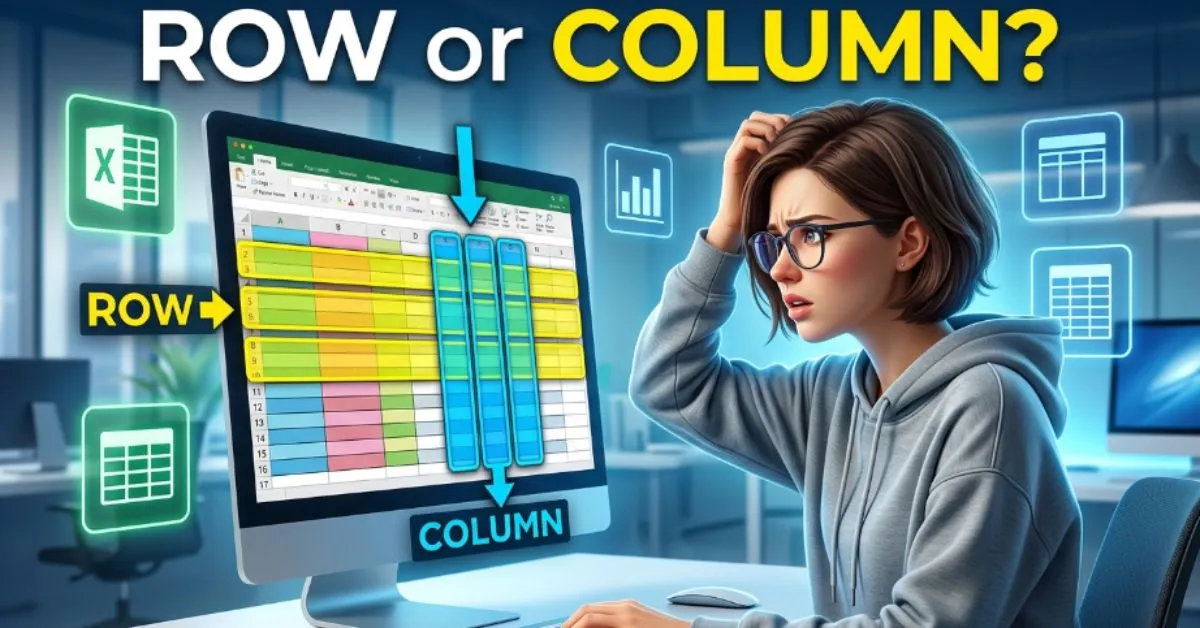
I still remember the first time I used a spreadsheet for work. My manager asked me to “highlight the third column,” and I confidently selected a row instead. Everyone paused for a second, and I instantly realized I had mixed them up again.
Honestly, I used to confuse row and column all the time. In school, during Excel work, and even while reading tables online, I kept forgetting which one goes sideways and which one goes up and down. The words sounded simple, but my brain somehow flipped them every single time.
Later, I discovered that many people struggle with the same confusion. Students, bloggers, office workers, freelancers, and even experienced professionals sometimes mix up rows and columns, especially when working with spreadsheets, databases, and tables.
If you’ve ever paused while using Excel or Google Sheets and wondered, “Wait… is this a row or a column?” then this guide is exactly what you need.
The good news is that there’s a very easy way to remember the difference forever. Once you learn this simple trick, you’ll never confuse row and column again.
⚡Row or Column – Quick Answer
A row goes horizontally from left to right.
A column goes vertically from top to bottom.
Easy Examples:
- ✅ Rows are numbered: 1, 2, 3
- ✅ Columns use letters: A, B, C
- ✅ In Excel, “A1” means Column A and Row 1
Simple Memory Trick:
- Row = Road → goes across
- Column = Climb → goes up and down
🤔 Why Do People Confuse Row or Column?
People confuse row and column because both are used together inside tables, spreadsheets, and charts. When you look at a grid full of boxes, it’s easy for your eyes to lose direction.
Another reason is that the words sound equally important. Unlike “up” and “down,” row and column do not naturally explain direction.
Many students first learn these terms in math or computer classes. But teachers often explain them quickly, and people memorize them without fully understanding them.
Technology also adds confusion. In apps like Microsoft Excel or Google Sheets, users constantly switch between rows and columns while entering data. One small mistake can throw off an entire table.
The biggest problem is visual memory. Some people remember sideways better, while others remember vertical structures more easily. That’s why many users need a simple trick instead of a technical explanation.
Once you connect rows with horizontal movement and columns with vertical movement, the confusion usually disappears.
📜 The Origin of Row or Column
The words row and column come from old Latin and French roots.
Row
The word “row” originally referred to a line of things placed side by side. For example:
- a row of chairs
- a row of houses
- a row of plants
That idea later became part of tables and spreadsheets.
Column
The word “column” comes from the Latin word columna, meaning pillar. A pillar stands upright, which explains why columns go vertically.
This history actually makes the meanings easier to remember:
- Rows spread across
- Columns stand tall
Over time, these terms became common in:
- mathematics
- architecture
- newspapers
- databases
- spreadsheets
Today, they are used everywhere from classrooms to business offices.
🌍 British vs American English
Unlike many English words, row and column are spelled the same in both British and American English.
However, usage may slightly change depending on context.
| Word | American English | British English | Meaning |
| Row | Same spelling | Same spelling | Horizontal line |
| Column | Same spelling | Same spelling | Vertical section |
Small Difference in Pronunciation
In American English, “row” sometimes sounds stronger and flatter. In British English, pronunciation may sound softer depending on the accent.
But the meaning stays exactly the same.
So whether you are in the USA, UK, Canada, or Australia, rows and columns work the same way.
🎯 Which One Should You Use?
You should use both correctly based on direction.
Use “Row” When:
- Something goes left to right
- Talking about horizontal lines
- Referring to numbered spreadsheet lines
Use “Column” When:
- Something goes top to bottom
- Talking about vertical sections
- Referring to lettered spreadsheet areas
For Bloggers
If you write tutorials about Excel, databases, or tables, using row and column correctly improves trust and readability.
For Freelancers
Clients often request spreadsheet work. Knowing the difference prevents errors and saves time.
For SEO
Many people search:
- “row vs column”
- “difference between row and column”
- “what is a row”
- “what is a column”
Using these variations naturally can improve search rankings.
Best Tip
Whenever you feel confused:
- Rows run across
- Columns stand tall
That one line solves most mistakes instantly.
❌ Common Mistakes (Avoid These!)
Here are the mistakes people make most often.
Mistake #1: Mixing Directions
❌ “Rows go up and down.”
✅ Rows go left to right.
Mistake #2: Confusing Excel Labels
❌ “Column 4 is D.”
✅ Row 4 is numbered; Column D uses letters.
Mistake #3: Using Both Words Interchangeably
❌ “Put the names in the row A.”
✅ Put the names in Column A.
Mistake #4: Forgetting Spreadsheet Structure
❌ Selecting a row instead of a column
✅ Double-check the direction before clicking.
Mistake #5: Confusing Tables in Writing
❌ “The article was arranged in rows vertically.”
✅ Columns are vertical.
📝 Real Life Examples
Here’s how row and column appear in everyday life.
Emails
- “Please enter the prices in Column B.”
- “Delete the empty row at the bottom.”
Social Media
- “I accidentally deleted the wrong column in Excel!”
- “Why do I always mix up rows and columns?”
News
- “The newspaper added a new opinion column.”
- “The data table included six rows of results.”
Formal Writing
- “The spreadsheet contains 20 rows and 5 columns.”
- “Each column represents a separate category.”
📊 Quick Comparison Table
| Feature | Row | Column |
| Direction | Horizontal | Vertical |
| Movement | Left to right | Top to bottom |
| Spreadsheet Labels | Numbers | Letters |
| Example | Row 5 | Column C |
| Memory Trick | Road across | Pillar standing |
| Common Use | Data lines | Data categories |
FAQs❓
Q. What is the difference between a row and a column?
A row goes horizontally, while a column goes vertically.
Q. Are rows horizontal?
Yes. Rows move from left to right.
Q. Are columns vertical?
Yes. Columns go from top to bottom.
Q. How do you remember row vs column?
Think:
- Row = Road across
- Column = Pillar standing up
Q. In Excel, are rows numbered?
Yes. Rows use numbers like 1, 2, and 3.
Q. In Excel, are columns lettered?
Yes. Columns use letters like A, B, and C.
Q. Which comes first in Excel: row or column?
Excel cell names start with the column letter first, then the row number.
Example:
- B4 = Column B, Row 4
Q. Why do people confuse rows and columns?
Because both appear together in tables and spreadsheets, making direction harder to remember.
Conclusion 🎯
Understanding row or column becomes much easier once you focus on direction. Rows move across from left to right, while columns go vertically from top to bottom. That’s the core difference.
Many people confuse these terms because they usually appear together inside tables, spreadsheets, and charts. It’s a very common mistake, especially for beginners using Excel or Google Sheets.
The easiest way to remember them is with simple visual tricks:
- Row = road across
- Column = pillar standing tall
Once you connect those images in your mind, the confusion almost disappears.
Whether you are a student, blogger, freelancer, office worker, or business owner, knowing the correct difference helps you work faster and communicate more clearly. It also prevents mistakes when handling spreadsheets and data tables.
The next time someone asks you to select a row or a column, you won’t need to pause and guess anymore.
Just remember:
- Rows run sideways
- Columns stand upright
That one simple rule can save you from years of confusion.
Discover More Articles:
- Sleave or Sleeve : Correct Spelling Explained in Simple English(2026)
- 🥤 Soda or Pop : The Shocking Difference Most Americans Don’t Notice
- 🍎 Fruits or Vegetables : The Simple Rule That Explains Everything