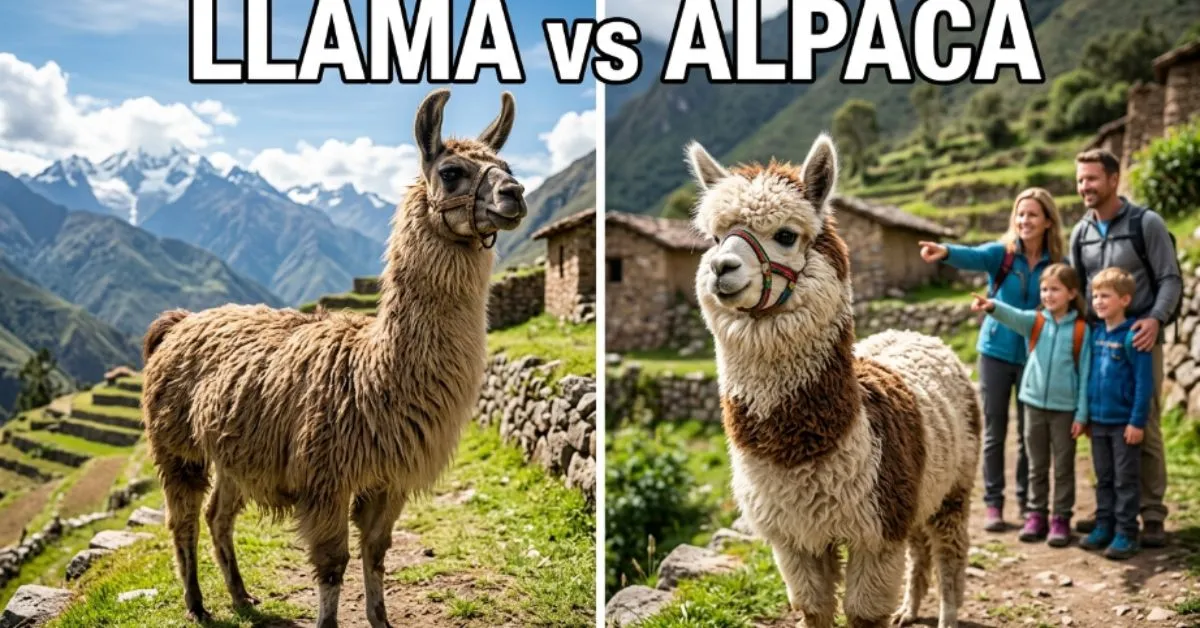
I still remember visiting a local petting zoo during a family trip. There were two fluffy animals standing near the fence, and I confidently pointed to one and said, “Look at that alpaca!” A staff member smiled and gently corrected me. It was actually a llama.
At first, I felt a little embarrassed. The two animals looked almost identical to me. They both had long necks, soft fur, and adorable faces. I figured most people would make the same mistake. Later, I discovered that countless travelers, animal lovers, students, and even bloggers regularly confuse llamas and alpacas.
The confusion makes sense. These animals are closely related, come from the same region of South America, and share many physical features. Photos online often make them look nearly identical. As a result, many people struggle to tell them apart.
If you’ve ever wondered whether you’re looking at a llama or an alpaca, you’re definitely not alone. The good news is that learning the difference is much easier than most people think.
In this guide, I’ll explain the key differences between llama or alpaca, why people confuse them, where they come from, and a simple trick that will help you identify them correctly every time.
⚡Llama or Alpaca – Quick Answer
Llamas and alpacas are different animals, although they belong to the same camelid family.
Llamas are larger and are often used as pack animals.
Alpacas are smaller and are mainly raised for their soft fleece.
Quick Examples
- Large animal with banana-shaped ears? → Llama. ✅
- Smaller animal with fluffy wool? → Alpaca. ✅
- All alpacas are llamas. ❌
The easiest way to remember the difference is that llamas are larger, while alpacas are fluffier.
🤔 Why Do People Confuse Llama or Alpaca?
People confuse llamas and alpacas because they share many similarities.
Both animals:
- Come from South America
- Have long necks
- Belong to the camelid family
- Produce wool-like fiber
- Look similar in photographs
Another reason is that many Americans rarely encounter these animals in everyday life. Most people only see them in zoos, farms, social media posts, or travel documentaries.
Their names can also create confusion. The words llama and alpaca are often mentioned together in articles, videos, and travel guides.
Distance adds to the problem as well. When viewed from far away, the differences become difficult to spot.
Because of these factors, even experienced animal lovers occasionally mistake one for the other.
📜 The Origin of Llama and Alpaca
Understanding the history of these animals helps explain why they are so closely related.
The Origin of Llamas
Llamas were domesticated thousands of years ago in the Andes Mountains of South America.
Ancient civilizations used them for:
- Carrying supplies
- Transporting goods
- Agricultural work
- Companionship
Because of their strength and endurance, llamas became valuable pack animals.
The Origin of Alpacas
Alpacas were also domesticated in the Andes region.
However, they were primarily bred for their luxurious fleece.
Their fiber became highly prized because it is:
- Soft
- Warm
- Lightweight
- Durable
Today, alpaca wool remains popular worldwide for clothing, blankets, and luxury textiles.
Although both animals share common ancestors, humans selectively bred them for different purposes.
🌍 British vs American English
Unlike spelling debates such as color vs colour or organize vs organise, there are no spelling differences between llama and alpaca in British and American English.
| Term | American English | British English | Difference |
| Llama | Llama | Llama | None |
| Alpaca | Alpaca | Alpaca | None |
| Llama Wool | Llama Wool | Llama Wool | None |
| Alpaca Fiber | Alpaca Fiber | Alpaca Fiber | None |
Whether you’re writing for a USA, UK, Canadian, or Australian audience, the spelling remains exactly the same.
🎯 Which One Should You Use?
The answer depends on what you’re talking about.
Use “Llama” When Referring To:
- Pack animals
- Larger camelids
- Farm animals used for carrying loads
- Animals with long banana-shaped ears
Examples:
- The llama carried equipment through the mountains.
- Farmers use llamas as guard animals.
Use “Alpaca” When Referring To:
- Luxury fleece production
- Smaller camelids
- Wool and textile industries
- Fluffy farm animals
Examples:
- Alpaca sweaters are extremely soft.
- The alpaca’s fleece is highly valuable.
For Bloggers and SEO Writers
Use llama-related keywords when discussing:
- Llama facts
- Llama behavior
- Llama farming
- Llama trekking
Use alpaca-related keywords when discussing:
- Alpaca wool
- Alpaca clothing
- Alpaca farms
- Alpaca fiber
Understanding search intent helps create more useful content and improves SEO performance.
❌ Common Mistakes (Avoid These!)
Mistake #1: Thinking They Are the Same Animal
❌ Wrong: Llamas and alpacas are identical.
✅ Correct: They are different species with different purposes.
Mistake #2: Judging Only by Fur
❌ Wrong: Fluffy fur automatically means llama.
✅ Correct: Alpacas are generally much fluffier.
Mistake #3: Ignoring Ear Shape
❌ Wrong: Ear shape doesn’t matter.
✅ Correct: Llamas have longer banana-shaped ears.
Mistake #4: Assuming Size Doesn’t Matter
❌ Wrong: Both animals are the same size.
✅ Correct: Llamas are usually much larger than alpacas.
📝 Real Life Examples
Emails
“I visited an alpaca farm during my vacation and learned how fleece is processed.”
Social Media
“Just met the cutest alpaca today! Its wool was unbelievably soft.”
News
“Farmers reported increased demand for alpaca fiber products.”
Formal Writing
“Llamas continue to serve important roles in livestock management throughout parts of South America.”
Additional Examples
- The llama carried supplies up the mountain trail.
- The alpaca produced high-quality fleece.
- Visitors enjoyed feeding the llamas.
- Alpaca wool is popular in winter clothing.
📊 Quick Comparison Table
| Feature | Llama | Alpaca |
| Size | Larger | Smaller |
| Purpose | Pack animal | Fiber production |
| Ears | Banana-shaped | Short and pointed |
| Face | Longer | Fluffier |
| Weight | Heavier | Lighter |
| Fiber Quality | Coarser | Softer |
| Temperament | Independent | More timid |
| Region | South America | South America |
FAQs❓
Q. What is the main difference between a llama and an alpaca?
Llamas are larger and used as pack animals, while alpacas are smaller and raised for fleece.
Q. Which animal has softer wool?
Alpacas produce much softer and finer fiber.
Q. Are llamas and alpacas related?
Yes. Both belong to the camelid family.
Q. Can llamas and alpacas live together?
Yes. Many farms raise them together.
Q. Which animal is bigger?
Llamas are significantly larger than alpacas.
Q. Do llamas spit?
Yes. Llamas can spit, especially when annoyed or establishing social boundaries.
Q. Are alpacas friendly?
Most alpacas are gentle and calm, although they can be shy.
Q. How can I quickly tell them apart?
Look at the ears. Llamas have long banana-shaped ears, while alpacas have shorter, pointed ears.
Conclusion 🎯
The debate over llama or alpaca is one of the most common animal identification questions people ask. I used to think they were basically the same animal until I learned a few simple differences. Once you know what to look for, telling them apart becomes surprisingly easy.
The key distinction is their purpose. Llamas are larger animals traditionally used for carrying loads and protecting livestock. Alpacas are smaller and primarily valued for their exceptionally soft fleece.
Physical features also make identification easier. Llamas have longer faces and banana-shaped ears. Alpacas have fluffier faces, softer wool, and shorter pointed ears.
Remember this simple trick: Large equals llama, fluffy equals alpaca. That one memory aid can help you identify them almost instantly.
The next time you visit a farm, zoo, or wildlife attraction, take a closer look. Chances are you’ll finally know whether you’re looking at a llama or an alpaca and you’ll avoid a mistake that confuses millions of people every year.
Discover More Articles:
- 🐾 Voles or Moles : The Easy Difference Explained (2026)
- 🐆 Leopard or Cheetah : The Hidden Difference Wildlife Fans Always Miss
- 👹 Cerebus or Cerberus : The Easy Trick to Never Mix Them Up Again

I’m Veronica Roth, an author at GrammarGuides.com, where I make English easy to understand. As a grammar expert, I help readers master spelling, punctuation, and common language mistakes.