I still remember sitting in a hospital waiting room when I overheard two people talking about becoming a PA and an NP. At first, I honestly thought they were almost the same job. Both worked with patients, both could diagnose illnesses, and both seemed to help doctors in similar ways.
But then one person said, “NPs usually come from a nursing background,” while another explained that PAs follow a medical school style training model. That completely confused me.
Later, while researching healthcare careers online, I realized thousands of students were asking the same question:
“What’s the real difference between a PA and an NP?”
The more I searched, the more mixed the answers became. Some websites claimed NPs have more independence. Others argued PAs have broader medical training. Social media discussions made it even harder to understand.
If you’ve ever searched “PA or NP?” and felt overwhelmed, you are definitely not alone. Many students, career changers, and even patients still confuse these healthcare roles every day.
The good news is that the difference is actually much simpler than it sounds. In this guide, I’ll explain PA vs NP in easy English so you can clearly understand which role does what and which career path may fit you best.
⚡ PA or NP – Quick Answer
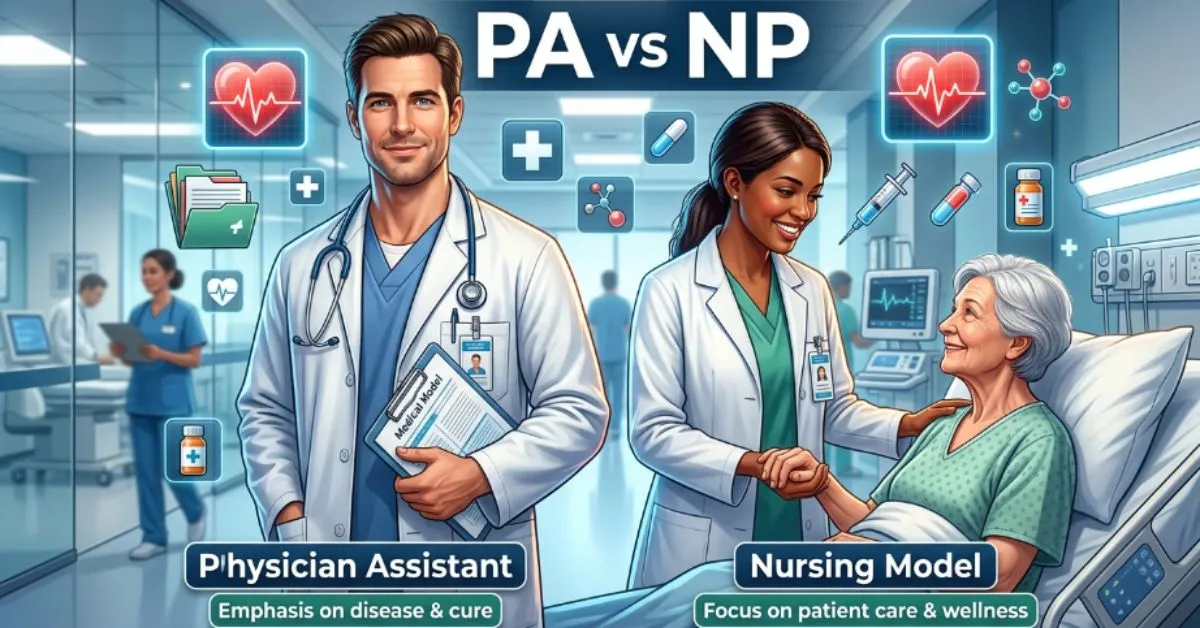
A PA (Physician Assistant) and an NP (Nurse Practitioner) are both advanced healthcare professionals who diagnose illnesses, treat patients, and prescribe medication.
The biggest difference is their training background:
- PAs train using a medical model.
- NPs train using a nursing model.
Quick Examples:
- ✅ PA → medical school style training
- ✅ NP → advanced nursing training
- ✅ Both can work in hospitals and clinics
Simple Rule:
PA = medical approach
NP = nursing approach
🤔 Why Do People Confuse PA or NP?
People confuse PA and NP because their daily jobs often look very similar.
Both can:
- examine patients
- diagnose illnesses
- prescribe medicine
- order tests
- work in hospitals and clinics
To patients, they may appear almost identical during appointments.
Another reason for confusion is that both professions are growing rapidly in the USA. Many healthcare offices now use PAs and NPs alongside doctors to improve patient care.
The abbreviations also create confusion:
- PA
- NP
These short titles do not clearly explain the differences to beginners.
Social media adds even more misunderstanding. Some people incorrectly assume one role is “better” than the other. In reality, both careers are highly respected and valuable in healthcare.
The biggest difference is education and training style:
- PAs are trained more broadly in medicine.
- NPs build on nursing experience and patient centered care.
Once people understand that foundation, the confusion becomes much easier to solve.
📜 The Origin of PA or NP
Both careers were created to help solve healthcare shortages in the United States.
PA (Physician Assistant)
The PA profession started in the 1960s. Many former military medics returning from war already had strong medical experience. Doctors needed trained professionals to help care for growing patient populations.
That led to the creation of the Physician Assistant role.
PA programs were designed using a medical school style model focused on:
- diagnosis
- treatment
- clinical medicine
NP (Nurse Practitioner)
The NP profession also began in the 1960s.
Nurse Practitioners were created to expand healthcare access, especially in underserved communities.
NPs first trained as registered nurses (RNs) before completing advanced education focused on:
- patient care
- prevention
- nursing practice
Over time, both professions became highly important parts of modern healthcare systems.
🌍 British vs American English
The terms PA and NP are mainly used in the United States.
Other countries may use different healthcare titles and systems.
| Term | USA | UK | Meaning |
| PA | Very common | Growing usage | Physician Assistant |
| NP | Very common | Common | Nurse Practitioner |
| Physician Associate | Rare | Common in UK | Similar to PA |
Important Difference
In the UK, the term “Physician Associate” is often used instead of Physician Assistant.
In the USA:
- PA remains the standard term.
- NP remains widely used.
🎯 Which One Should You Use?
The best career choice depends on your interests, background, and goals.
Choose PA If:
- You want broad medical training
- You may switch specialties often
- You enjoy fast paced medical environments
- You prefer the medical model
Choose NP If:
- You already work in nursing
- You enjoy patient centered care
- You want a nursing based approach
- You value preventive healthcare focus
For Career Flexibility
PAs often move between specialties more easily without needing additional certifications.
For Nursing Professionals
Many registered nurses naturally continue toward becoming NPs.
For Bloggers and SEO
Many people search:
- “PA vs NP”
- “difference between PA and NP”
- “should I become a PA or NP”
Using both keywords naturally can improve search rankings.
Best Practical Advice
Neither career is automatically better. The best option depends on your personality, education path, and long term career goals.
❌ Common Mistakes (Avoid These!)
Here are the biggest mistakes people make.
Mistake #1: Thinking They Are Identical
❌ “PA and NP are exactly the same.”
✅ Their training models are different.
Mistake #2: Assuming PAs Are Nurses
❌ “A PA is basically a nurse.”
✅ PAs follow medical model training.
Mistake #3: Assuming NPs Are Doctors
❌ “NP means medical doctor.”
✅ NPs are advanced nursing professionals.
Mistake #4: Ignoring State Laws
❌ “PAs and NPs have identical authority everywhere.”
✅ Rules vary by state.
Mistake #5: Choosing Based Only on Salary
❌ Picking a career only for money
✅ Consider lifestyle, interests, and training path too.
📝 Real Life Examples
Here’s how PA or NP appears in daily life.
Emails
- “The PA will review your test results.”
- “Our clinic recently hired a new NP.”
Social Media
- “Trying to decide between PA school and NP school.”
- “NP life is challenging but rewarding!”
News Headlines
- “Demand for NPs continues rising across the USA.”
- “Hospitals increasingly rely on PAs for patient care.”
Formal Writing
- “The patient was evaluated by a certified PA.”
- “The NP provided follow up treatment recommendations.”
📊 Quick Comparison Table
| Feature | PA | NP |
| Full Form | Physician Assistant | Nurse Practitioner |
| Training Model | Medical | Nursing |
| Background Needed | Various science backgrounds | Nursing background |
| Focus | Broad medical care | Patient centered care |
| Career Flexibility | High | Moderate |
| Common Workplace | Hospitals & clinics | Hospitals & clinics |
| Prescribe Medication | Yes | Yes |
| USA Popularity | Very high | Very high |
FAQs ❓
Q. What is the difference between a PA and NP?
A PA follows medical model training, while an NP follows nursing model training.
Q. Who earns more: PA or NP?
Salaries vary by specialty, location, and experience. Both careers can earn high incomes.
Q. Is PA school harder than NP school?
Both are challenging but focus on different training styles.
Q. Can PAs prescribe medication?
Yes. PAs can prescribe medications in most states.
Q. Can NPs work independently?
In some states, NPs can practice independently.
Q. Do PAs and NPs do the same job?
They often perform similar tasks, but their training backgrounds differ.
Q. Which is better: PA or NP?
Neither is universally better. The right choice depends on your goals and interests.
Q. Can a nurse become a PA?
Yes. Nurses can apply to PA school if they meet admission requirements.
Conclusion
Understanding PA or NP becomes much easier once you focus on the training path behind each role. PAs are educated using a medical model, while NPs build on nursing education and patient centered care.
Even though their daily responsibilities often overlap, their backgrounds and approaches are different. That’s why both careers continue playing important roles in modern healthcare.
If you enjoy broad medical training and flexibility across specialties, becoming a PA may feel like the better fit. If you already work in nursing and enjoy long term patient care, the NP path may feel more natural.
The biggest mistake people make is assuming one career is automatically superior. In reality, both professions are respected, rewarding, and highly valuable.
The next time someone asks about PA vs NP, you’ll clearly understand the difference:
- PA = medical model training
- NP = nursing model training
That one simple rule can help you avoid confusion and make smarter healthcare career decisions.
Discover More Articles:
- Passtime or Pastime : Common Spelling Mistake Explained✍️(2026)
- Focussing or Focusing : Simple Answer (With Examples)🎯(2026)
- Tough or Tuff : The Simple Guide for Writers and Social Media💪(2026)

I’m David Mitchell, an author at GrammarGuides.com where I help readers understand English more clearly. As a grammar expert, I share simple explanations and tips to fix common spelling and grammar mistakes.