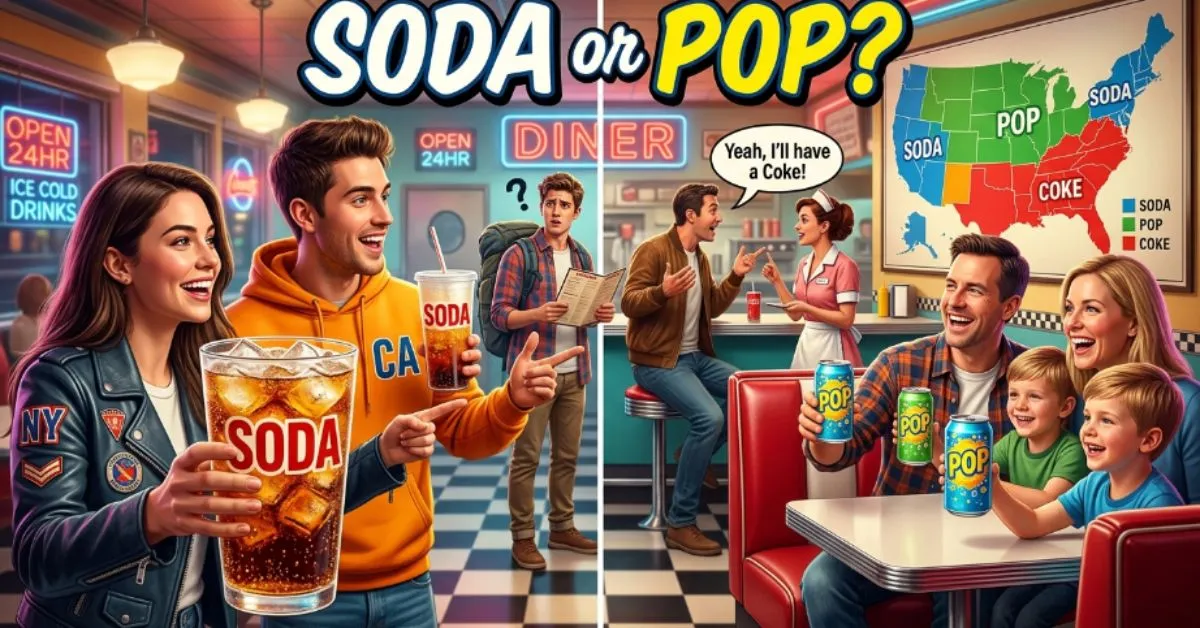
I still remember the first time I got completely confused ordering a drink during a road trip in the United States. I walked into a small restaurant, smiled at the cashier, and asked, “Can I get a soda?” The cashier paused for a second and replied, “You mean pop?” Honestly, I thought he was joking. To me, soda and pop were basically random words people used for the exact same drink. I had no idea certain parts of America strongly preferred one word over the other.
But things became even more confusing when another person nearby suddenly called it “coke” even though the drink wasn’t actually Coca-Cola. That’s when I realized something surprising: The words soda, pop, and coke are part of one of the biggest language debates in American culture.
If you’ve ever wondered why people say soda or pop depending on where they live, you are definitely not alone. Millions of Americans use different words for soft drinks based on region, family habits, and local culture. The good news? Once you understand the regional differences, the confusion becomes incredibly easy to solve.
In this guide, I’ll explain the real difference between soda or pop, why people confuse them, where the terms came from, and which version you should use. By the end, you’ll never feel awkward ordering a soft drink again.
⚡ Soda or Pop – Quick Answer
“Soda” and “pop” usually mean the exact same thing:
a sweet carbonated soft drink.
The difference is mainly regional.
Quick Examples:
- “Can I get a soda?” → Common in places like California and New York
- “Can I get a pop?” → Common in the Midwest
- Both usually mean soft drinks like cola or lemonade
The easiest rule:
Soda and pop are different regional words for the same beverage.
🤔 Why Do People Confuse Soda or Pop?
People confuse soda and pop because Americans use different words depending on where they live.
In some states, almost everyone says:
- soda
In others, people naturally say:
- pop
And in parts of the southern United States, many people casually call all soft drinks:
- coke
That creates confusion quickly.
Another reason is travel. Someone from New York may ask for soda in Michigan and hear people calling it pop instead.
The drinks are usually identical.
Only the vocabulary changes.
The confusion also grows online because social media constantly debates:
- soda vs pop map,
- regional slang,
- and American language differences.
Once you realize this is mainly a regional language difference, everything becomes much easier.
📜 The Origin of Soda or Pop
The word “soda” comes from “soda water,” a fizzy carbonated drink popular during the 1800s.
The bubbling effect came from sodium-based mineral waters, which helped create the name “soda.”
The word “pop” likely came from the popping sound created when old glass bottles were opened.
That sound became strongly connected to fizzy soft drinks in many American regions.
Over time:
- western and eastern states preferred “soda,”
- while many Midwestern areas preferred “pop.”
Unlike spelling confusion topics like “gray vs grey,” soda and pop are not spelling variations.
They are regional vocabulary differences.
Today, both terms remain extremely common across the United States.
🌍 British vs American English
There is a difference between American and British usage here.
Americans commonly say:
- soda
- pop
- soft drink
British English more commonly uses:
- fizzy drink
- soft drink
Comparison Table
| Word | American English | British English | Meaning |
| Soda | Very common | Less common | Carbonated soft drink |
| Pop | Regional US term | Rare | Sweet fizzy drink |
| Fizzy Drink | Rare in US | Very common | Carbonated beverage |
The meaning stays similar, but regional wording changes.
🎯 Which One Should You Use?
Choose the version that fits your audience and location.
Use “Soda” When:
- writing for broad American audiences,
- targeting national SEO traffic,
- or speaking in western/eastern US regions.
Use “Pop” When:
- speaking casually in Midwest regions,
- discussing local culture,
- or quoting regional American speech.
For Bloggers and SEO Writers
“Soda” usually performs better nationally because it has broader search volume.
However, “pop” may perform better for regional audiences in places like:
- Michigan,
- Ohio,
- Minnesota,
- and Wisconsin.
For Freelancers and Content Creators
Regional language creates authenticity.
Using local vocabulary correctly makes content feel more natural and relatable.
❌ Common Mistakes (Avoid These!)
Many people accidentally misuse soda and pop terms.
Mistake #1: Thinking They Are Different Drinks
❌ Wrong: “Pop and soda are different beverages.”
✅ Correct: “They usually mean the same drink.”
Mistake #2: Assuming Everyone Uses the Same Word
❌ Wrong: “All Americans say soda.”
✅ Correct: “Different regions prefer different words.”
Mistake #3: Confusing “Coke” Usage
❌ Wrong: “Every soft drink is literally Coca-Cola.”
✅ Correct: “Some southern regions use ‘coke’ generally.”
Mistake #4: Thinking “Pop” Is Old-Fashioned Everywhere
❌ Wrong: “Nobody says pop anymore.”
✅ Correct: “Millions still use it daily.”
Mistake #5: Ignoring Audience Location
❌ Wrong: “Regional wording never matters.”
✅ Correct: “Language changes based on local culture.”
📝 Real Life Examples
Here’s how soda and pop are used correctly in everyday writing.
Emails
“We ordered pizza and soda for the office party.”
“Don’t forget to grab some pop for the barbecue.”
Social Media
“People who say pop instead of soda confuse me.”
“Midwest families will always call it pop.”
News and Culture Content
“Regional soda vocabulary continues fascinating linguists.”
“Americans remain divided in the soda vs pop debate.”
Formal Writing
“The term used for carbonated beverages varies by region.”
“Soda remains the most recognized national term.”
🥤 Soda vs Pop: The Main Difference
Here’s the easiest way to understand the difference.
| Feature | Soda | Pop |
| Meaning | Carbonated soft drink | Carbonated soft drink |
| Main Usage | National US usage | Midwest US usage |
| Popular Regions | East & West Coast | Midwest |
| Tone | More universal | More regional |
| Common Examples | Cola, Sprite, Pepsi | Cola, Sprite, Pepsi |
| British Equivalent | Fizzy drink | Fizzy drink |
The beverage is usually identical.
Only the regional wording changes.
🗺️ Where Americans Say “Soda” or “Pop”
The United States has clear regional language patterns.
Areas That Commonly Say “Soda”
- California
- New York
- Florida
- Arizona
- New England states
Areas That Commonly Say “Pop”
- Michigan
- Ohio
- Minnesota
- Iowa
- Wisconsin
Areas That Often Say “Coke”
Parts of the southern US may use “coke” for many soft drinks.
For example:
“What kind of coke do you want?”
Possible answer:
“Sprite.”
That surprises many visitors instantly.
🧠 Why the Debate Became So Famous
The soda vs pop debate became popular because it reflects American identity and regional culture.
People strongly connect these words to:
- hometown traditions,
- family habits,
- and local pride.
Social media made the debate even bigger through:
- memes,
- regional maps,
- and funny arguments online.
Many Americans instantly recognize where someone grew up based on whether they say:
- soda,
- pop,
- or coke.
That makes this language debate surprisingly personal and entertaining.
📊 Quick Comparison Table
| Term | Meaning | Category | Common Usage | Region |
| Soda | Carbonated soft drink | Beverage term | National US usage | USA |
| Pop | Carbonated soft drink | Beverage term | Midwest speech | USA |
| Fizzy Drink | Carbonated beverage | Beverage term | British English | UK |
FAQs ❓
Q. Is soda the same as pop?
Yes. Both usually mean carbonated soft drinks.
Q. Why do Midwesterners say pop?
Regional culture and historical language patterns shaped the term.
Q. Which word is more common: soda or pop?
“Soda” is generally more common nationally.
Q. Why do some people say coke for every soft drink?
Certain southern US regions use “coke” generically.
Q. Is pop used in British English?
Not commonly. British English usually says “fizzy drink.”
Q. Is soda an American word?
Yes. It is heavily associated with American English.
Q. Are soda and soft drink the same thing?
Usually yes.
Q. Which term is better for SEO?
“Soda” generally has broader national search traffic.
🎯 Conclusion
Understanding the difference between soda or pop becomes very simple once you know the debate is mostly regional.
Both words describe:
- sweet carbonated beverages,
- fizzy soft drinks,
- and common American drinks.
The main difference is location.
“Soda” dominates many western and eastern states, while “pop” remains extremely popular in the Midwest.
Some southern regions even prefer:
- “coke”
for almost any soft drink.
People confuse these terms because Americans grow up using different vocabulary depending on local culture and family habits.
The easiest trick to remember is simple:
Soda and pop are usually the same drink only the regional wording changes.
The next time someone orders soda or pop, you’ll instantly understand why they use that word.
And you’ll never feel confused by the famous American drink debate again.
Discover More Articles:
- Site or Cite : Learn the Difference in Under 60 Seconds💡(2026)
- Donder or Donner : The Simple Truth Americans Get Wrong Every Christmas🎄
- Loath or Loathe : Explained in 60 Seconds (No More Mistakes!)😮(2026)

I’m Veronica Roth, an author at GrammarGuides.com, where I make English easy to understand. As a grammar expert, I help readers master spelling, punctuation, and common language mistakes.