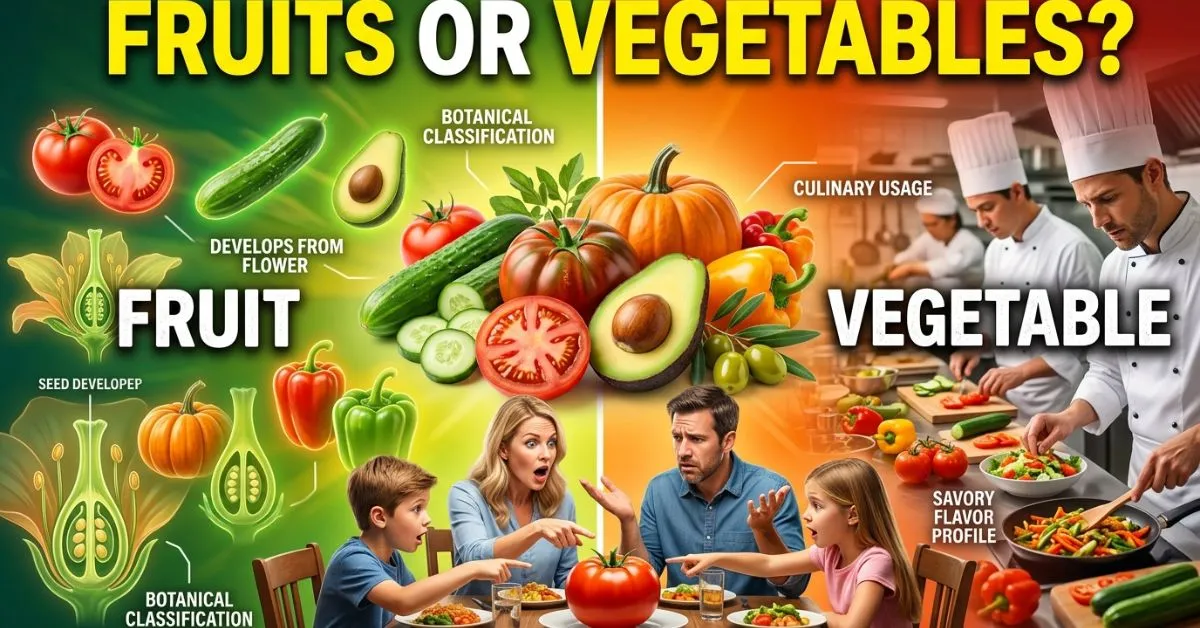
I still remember the moment I embarrassed myself during a family dinner debate. Someone casually said tomatoes were fruits, and I immediately laughed. “No way,” I said. “Tomatoes are obviously vegetables.” A few seconds later, everyone at the table started arguing. One person mentioned science. Another brought up cooking. Someone even started talking about cucumbers and pumpkins.
Honestly, I was completely confused. To me, fruits and vegetables seemed simple. Sweet foods were fruits. Savory foods were vegetables. That’s what I believed for years. But after searching online for “fruits or vegetables,” I discovered something surprising: Many foods people call vegetables are technically fruits.
That’s when things became even more confusing. Tomatoes, cucumbers, peppers, avocados, pumpkins, and even olives suddenly entered the debate. If you’ve ever wondered why some foods seem to belong in both categories, you are definitely not alone. Millions of people confuse fruits and vegetables because science and cooking use different definitions.
The good news? Once you learn one simple rule, understanding the difference becomes incredibly easy. In this guide, I’ll explain the real difference between fruits or vegetables, why people confuse them, where the terms came from, and the easiest tricks to identify them correctly. By the end, you’ll never mix them up again.
⚡ Fruits or Vegetables – Quick Answer
A fruit develops from the flower of a plant and usually contains seeds.
A vegetable comes from other plant parts like roots, stems, or leaves.
Quick Examples:
- Tomato = technically a fruit
- Carrot = vegetable
- Apple = fruit
- Lettuce = vegetable
The easiest trick:
Seeds inside = usually a fruit.
🤔 Why Do People Confuse Fruits or Vegetables?
People confuse fruits and vegetables because science and cooking use different rules.
In botany (plant science):
- Fruits grow from flowers and contain seeds.
- Vegetables come from other plant parts.
But in cooking:
- Sweet foods are often called fruits.
- Savory foods are usually called vegetables.
That creates huge confusion.
For example:
- Tomatoes are botanical fruits.
- Cucumbers are fruits too.
- Bell peppers are technically fruits.
But most people cook them like vegetables.
Another reason is school learning. Many children grow up hearing:
- apples = fruit
- broccoli = vegetable
But they never learn the scientific definition behind it.
Once you understand the seed rule, the confusion becomes much easier to solve.
📜 The Origin of Fruits or Vegetables
The word “fruit” comes from old Latin and French roots connected to enjoyment, produce, and harvest.
Historically, fruits were linked to:
- sweetness,
- ripeness,
- and edible plant products.
The word “vegetable” comes from Latin roots related to growing plants and vegetation.
Over time, vegetables became associated with:
- leaves,
- roots,
- stems,
- and savory foods.
Unlike spelling confusion topics like “color vs colour,” fruits and vegetables are different food categories rather than alternate spellings.
Today:
- fruits are mainly connected to seed bearing plant parts,
- while vegetables describe edible roots, stems, leaves, and bulbs.
🌍 British vs American English
There is no spelling difference between British and American English for these words.
Both regions use:
- Fruit
- Vegetable
Comparison Table
| Word | American English | British English | Meaning |
| Fruit | Fruit | Fruit | Seed bearing plant food |
| Vegetable | Vegetable | Vegetable | Edible plant part |
The spelling remains identical worldwide.
🎯 Which One Should You Use?
Choose the correct term depending on the plant part you are describing.
Use “Fruit” When:
- discussing seed containing foods,
- talking about botanical classifications,
- or describing sweet plant foods.
Use “Vegetable” When:
- discussing roots, stems, or leaves,
- talking about cooking ingredients,
- or describing savory plant foods.
For Bloggers and SEO Writers
Correct terminology matters because search intent differs greatly.
Someone searching:
“best fruits for smoothies”
usually wants:
- sweet foods,
- vitamins,
- and healthy snacks.
Someone searching:
“healthy vegetables list”
usually wants:
- leafy greens,
- meal ideas,
- or nutrition advice.
Using accurate wording improves:
- SEO rankings,
- reader trust,
- and content clarity.
For Freelancers and Content Creators
Food and health content becomes much more professional when ingredients are classified correctly.
❌ Common Mistakes (Avoid These!)
Many people accidentally confuse fruits and vegetables.
Mistake #1: Thinking Sweetness Decides Everything
❌ Wrong: “If it tastes sweet, it must be a fruit.”
✅ Correct: “Some fruits are not sweet.”
Mistake #2: Calling Tomatoes Vegetables Scientifically
❌ Wrong: “Tomatoes are scientifically vegetables.”
✅ Correct: “Tomatoes are technically fruits.”
Mistake #3: Forgetting Seeds Matter
❌ Wrong: “Cucumbers are vegetables because they go in salads.”
✅ Correct: “Cucumbers are fruits because they contain seeds.”
Mistake #4: Assuming All Fruits Are Desserts
❌ Wrong: “Fruits are only for sweet dishes.”
✅ Correct: “Some fruits are used in savory meals.”
Mistake #5: Mixing Cooking and Science Rules
❌ Wrong: “Cooking definitions and scientific definitions are identical.”
✅ Correct: “Cooking and botany classify foods differently.”
📝 Real Life Examples
Here’s how fruits and vegetables are used correctly in everyday writing.
Emails
“We added more fresh fruits to the breakfast menu.”
“The recipe includes roasted vegetables and herbs.”
Social Media
“Avocados are technically fruits, which still surprises me.”
“Eating colorful vegetables daily improves nutrition.”
News and Health Content
“Doctors encourage higher fruit and vegetable intake.”
“Leafy vegetables remain important for balanced diets.”
Formal Writing
“Botanically, tomatoes are classified as fruits.”
“Vegetables provide essential vitamins and minerals.”
🔍 Fruits vs Vegetables: The Main Difference
Here’s the easiest way to understand the difference.
| Feature | Fruit | Vegetable |
| Comes From | Flower of plant | Other plant parts |
| Contains Seeds | Usually yes | Usually no |
| Taste | Often sweet | Often savory |
| Examples | Apple, tomato, cucumber | Carrot, lettuce, potato |
| Plant Part | Ovary/flower | Root, stem, leaf |
| Cooking Use | Desserts/snacks | Meals/sides |
This comparison makes identification much easier.
🍅 Foods That Confuse Everyone
Some foods constantly confuse people because they fit both cooking and scientific categories differently.
Technically Fruits:
- Tomatoes
- Cucumbers
- Bell peppers
- Pumpkins
- Zucchini
- Avocados
- Olives
Why?
Because they all develop from flowers and contain seeds.
Technically Vegetables:
- Carrots
- Potatoes
- Onions
- Celery
- Spinach
- Lettuce
- Broccoli
These come from roots, stems, leaves, or bulbs.
That’s why scientific and cooking definitions sometimes clash.
🥗 Why Cooking Uses Different Rules
Cooking focuses more on flavor than plant science.
In kitchens:
- sweet foods are treated as fruits,
- savory foods are treated as vegetables.
For example:
Tomatoes may be fruits scientifically, but chefs usually treat them like vegetables because they work better in:
- salads,
- sauces,
- and savory dishes.
That’s why many people grow up believing tomatoes are vegetables.
The same confusion happens with:
- cucumbers,
- peppers,
- and pumpkins.
Understanding the difference between cooking language and scientific language solves most confusion instantly.
🌱 The Simple Trick to Remember the Difference
Here’s the easiest trick beginners use.
Ask One Question:
Does it contain seeds?
If YES:
It is usually a fruit.
If NO:
It is usually a vegetable.
Examples:
- Apple → seeds → fruit
- Tomato → seeds → fruit
- Carrot → no seeds → vegetable
- Lettuce → no seeds → vegetable
This quick rule works most of the time and makes identification much easier.
📊 Quick Comparison Table
| Term | Meaning | Category | Common Usage | Region |
| Fruit | Seed bearing plant food | Plant category | Snacks, desserts, health | Worldwide |
| Vegetable | Edible root/stem/leaf | Plant category | Meals, cooking, nutrition | Worldwide |
FAQs ❓
Q. Is a tomato a fruit or vegetable?
Scientifically, a tomato is a fruit.
Q. Why are cucumbers fruits?
Because cucumbers develop from flowers and contain seeds.
Q. Are potatoes fruits?
No. Potatoes are vegetables because they are underground tubers.
Q. Is avocado a fruit?
Yes. Avocados contain seeds, making them fruits.
Q. Why do people call tomatoes vegetables?
Because they are commonly used in savory cooking.
Q. Are all fruits sweet?
No. Some fruits taste mild or savory.
Q. What is the easiest way to identify a fruit?
Check for seeds inside.
Q. Can a food be both a fruit and a vegetable?
Scientifically no, but cooking categories may differ from botanical ones.
🎯 Conclusion
Understanding the difference between fruits or vegetables becomes very simple once you focus on plant structure and seeds.
Fruits are:
- seed bearing plant parts,
- grown from flowers,
- and often sweet or juicy.
Vegetables are:
- roots,
- stems,
- leaves,
- or other edible plant parts.
People confuse them because cooking and science use different definitions. Foods like tomatoes, cucumbers, and peppers create the biggest debates because they are scientifically fruits but commonly cooked like vegetables.
The easiest trick to remember is simple:
Seeds inside = usually a fruit.
Roots, stems, or leaves = usually a vegetable.
Once you understand that rule, identifying foods becomes much easier instantly.
The next time someone starts arguing about whether tomatoes are fruits or vegetables, you’ll finally know the real answer.
And you’ll never confuse fruits and vegetables again.
Discover More Articles:
- Their or They’re : The Quick Fix You Need to Know✍️(2026)
- Oriented or Orientated : The Simple Rule That Saves Your Writing🤯(2026)
- Centre or Center : The Ultimate Guide for US Writers✍️(2026)

I’m Dan Brown, an author behind GrammarGuides.com, where I share simple tips to help people write English clearly and correctly. As a grammar expert, I enjoy explaining tricky words, spelling differences, and common language mistakes in an easy way.