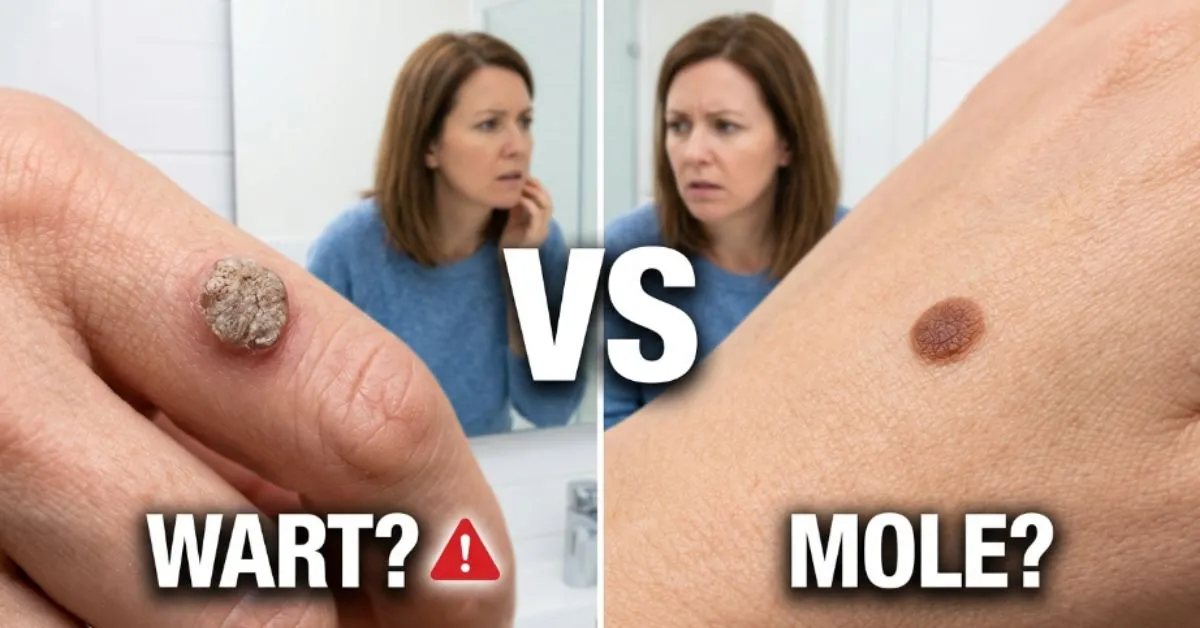
I still remember the day I noticed a small bump on my arm while getting ready in the morning. At first, I ignored it, thinking it was probably nothing serious. But over the next few weeks, I kept looking at it and wondering the same thing many people do: Is this a wart or a mole?
The more I searched online, the more confused I became. Some pictures looked exactly like what I had. Others made me think it could be something completely different. One article said warts are caused by a virus, while another explained that moles are usually related to skin pigmentation. Suddenly, a simple question didn’t seem so simple anymore.
Instead of guessing, I decided to learn the key differences between warts and moles and pay attention to their appearance and behavior. That made everything much clearer.
If you’ve ever looked at a spot on your skin and wondered it’s a wart or a mole, this guide will help you understand the difference in a simple and easy way.
⚡ Wart or Mole – Quick Answer
A wart is a skin growth caused by the human papillomavirus (HPV).
A mole is a cluster of pigment producing skin cells that develops naturally on the skin.
Quick Examples
- Rough bump on a finger? Often a wart.
- Small brown spot present for years? Often a mole.
- Raised growth that spreads? More likely a wart.
Simple Rule
Warts are virus related growths. Moles are pigment related skin spots.
🤔 Why Do People Compare Wart or Mole?
People compare warts and moles because:
- Both appear on the skin.
- Both can be small and raised.
- Both can develop almost anywhere on the body.
- Both may cause cosmetic concerns.
Many people assume that every raised skin spot is a mole. Others assume every bump is a wart.
In reality, they are very different conditions.
A wart is caused by a viral infection, while a mole develops from skin pigment cells called melanocytes.
Understanding this difference helps people make better decisions about treatment and monitoring.
📜 The Background Behind Both Options
Wart
Warts have been recognized for centuries.
They are caused by certain strains of the human papillomavirus (HPV). The virus enters the skin through tiny cuts or openings and causes excess skin growth.
Common types include:
- Common warts
- Plantar warts
- Flat warts
- Filiform warts
Mole
Moles develop when melanocytes grow in clusters rather than spreading evenly throughout the skin.
Many people are born with moles or develop them during childhood and early adulthood.
Most moles are harmless, though changes in appearance should be monitored.
Today, dermatologists view moles and warts as two entirely different skin conditions despite their similar appearance.
📊 Key Differences at a Glance
| Feature | Wart | Mole |
| Main Purpose | Viral skin growth | Pigmented skin spot |
| Cause | Human papillomavirus (HPV) | Melanocyte clusters |
| Appearance | Rough, textured | Smooth or slightly raised |
| Contagious | Yes | No |
| Color | Skin colored, gray, brown | Brown, black, tan, pink |
| Availability | Can appear anytime | Often develops early in life |
| Convenience | May require treatment | Usually harmless |
| Best For | Identifying viral growths | Monitoring skin pigmentation |
| Pros | Often removable | Usually harmless |
| Cons | Can spread | Some changes require evaluation |
🔍 Feature by Feature Comparison
Appearance
Warts usually have a rough texture.
They may feel grainy or uneven.
Moles are generally smoother and more uniform.
Cause
The biggest difference is origin.
Warts result from a viral infection.
Moles develop from pigment cells in the skin.
Contagiousness
Warts can spread.
They may spread:
- To other body areas
- Through skin contact
- Through shared surfaces
Moles are not contagious.
Growth Pattern
Warts may grow relatively quickly.
Moles often remain stable for years.
Color
Warts usually match the surrounding skin.
Moles often contain more pigment and appear darker.
Health Concerns
Most warts are harmless but can become annoying.
Most moles are harmless, but unusual changes should be evaluated by a healthcare professional.
💰 Pricing and Value Comparison
Since warts and moles are skin conditions rather than products, costs relate to treatment.
Wart Treatment Costs
May include:
- Over the counter wart removers
- Cryotherapy
- Prescription treatments
- Dermatology visits
Mole Treatment Costs
May include:
- Skin examinations
- Mole removal procedures
- Biopsy testing when necessary
Prices vary by location, provider, insurance coverage, and treatment method.
The best value depends on obtaining an accurate diagnosis before choosing treatment.
Pros and Cons ✅❌
Wart
Pros
- Often removable.
- Many treatment options available.
- Usually non serious.
Cons
- Can spread.
- May return after treatment.
- Sometimes painful.
- Can affect appearance.
Mole
Pros
- Usually harmless.
- Common and natural.
- Often stable for years.
Cons
- Some may become cosmetically bothersome.
- Changes may require medical evaluation.
- Removal can leave scars.
Who Should Choose Wart? 🎯
You may be dealing with a wart if:
- ✔ The growth feels rough.
- ✔ It appeared recently.
- ✔ Similar growths are spreading.
- ✔ It occurs on fingers, hands, feet, or knees.
- ✔ Small black dots appear inside the growth.
Common Scenarios
- School age children
- Athletes using shared facilities
- People with recurring skin growths
Who Should Choose Mole? 🎯
You may be dealing with a mole if:
- ✔ The spot has existed for years.
- ✔ It contains pigment.
- ✔ It appears brown, tan, black, or pink.
- ✔ It remains relatively stable.
- ✔ Family members have many moles.
Common Scenarios
- Long term skin markings
- Pigmented spots
- Beauty marks
❌ Common Mistakes People Make
Mistake #1
Assuming every bump is a wart.
Reality:
Many skin growths are not warts.
Mistake #2
Assuming every dark spot is a mole.
Reality:
Skin spots can have many causes.
Mistake #3
Trying aggressive home treatments without a diagnosis.
Reality:
Incorrect treatment may irritate the skin.
Mistake #4
Ignoring changing moles.
Reality:
Significant changes should be evaluated professionally.
Mistake #5
Thinking warts and moles are contagious.
Reality:
Only warts are contagious.
📝 Real Life Examples
Everyday Situations
A child develops a rough bump on a finger after swimming lessons. It turns out to be a wart.
Social Media
People frequently post photos asking whether a skin spot is a wart or a mole.
Reviews
Many consumers review wart removal products after successful treatment.
Professional Discussions
Dermatologists regularly differentiate between moles, warts, and other skin growths.
Consumer Decisions
People often choose between monitoring a mole or seeking removal for cosmetic reasons.
🤔 Things to Consider Before Choosing
Appearance
Is the spot rough or smooth?
History
Has it been there for years or appeared recently?
Symptoms
Does it itch, bleed, or change?
Treatment Goals
Are you seeking cosmetic improvement or medical treatment?
Long Term Monitoring
Moles should be monitored for noticeable changes.
Professional Evaluation
When uncertain, professional evaluation offers the most reliable answer.
📋 Quick Comparison Table
| Category | Winner |
| Contagious Condition | Wart |
| Pigmented Skin Spot | Mole |
| Cosmetic Stability | Mole |
| Likely to Spread | Wart |
| Best for Beginners to Identify | Mole |
| Most Common Viral Growth | Wart |
| Best Convenience | Mole |
| Overall Recommendation | Depends on diagnosis |
FAQs❓
Q. Is a wart the same as a mole?
No. Warts are caused by HPV, while moles are clusters of pigment cells.
Q. How can I tell if it’s a wart or mole?
Texture, color, and growth history often provide clues, but professional evaluation may be needed.
Q. Can a mole turn into a wart?
No. They develop for different reasons.
Q. Are warts dangerous?
Most are harmless but can spread.
Q. Are moles dangerous?
Most are harmless, but unusual changes should be evaluated.
Q. Can warts disappear on their own?
Yes. Some warts resolve without treatment.
Q. Do moles go away naturally?
Most remain for many years.
Q. Can I remove a wart at home?
Many over the counter treatments exist, but results vary.
Q. Should I remove a mole myself?
No. Mole removal should be performed by qualified healthcare professionals.
Q. When should I see a dermatologist?
If a skin growth changes, causes concern, or cannot be identified confidently.
Expert Tip 💡
Use this simple memory trick:
Wart = Virus. Mole = Pigment.
If you remember those two words, you’ll understand the biggest difference between these common skin growths.
Conclusion
The comparison between wart or mole often causes confusion because both appear as visible skin growths. However, they are very different conditions with different causes, appearances, and treatment approaches.
Warts are caused by the human papillomavirus and often appear as rough, textured growths that can spread. Moles, on the other hand, develop from pigment producing skin cells and are usually stable, non contagious, and harmless.
For most people, identifying whether a spot is rough and newly developed or pigmented and long standing can provide helpful clues. Still, appearance alone is not always enough to make a reliable diagnosis.
The safest approach is to monitor any skin growth for changes in size, shape, color, or texture. If something seems unusual, painful, or concerning, professional evaluation is the best next step.
Rather than guessing, focus on understanding the key distinction: warts are viral growths, while moles are pigment based skin spots. Knowing that difference can help you make more informed decisions about your skin health and determine whether treatment or monitoring may be appropriate.

I’m Dan Brown, an author behind GrammarGuides.com, where I share simple tips to help people write English clearly and correctly. As a grammar expert, I enjoy explaining tricky words, spelling differences, and common language mistakes in an easy way.