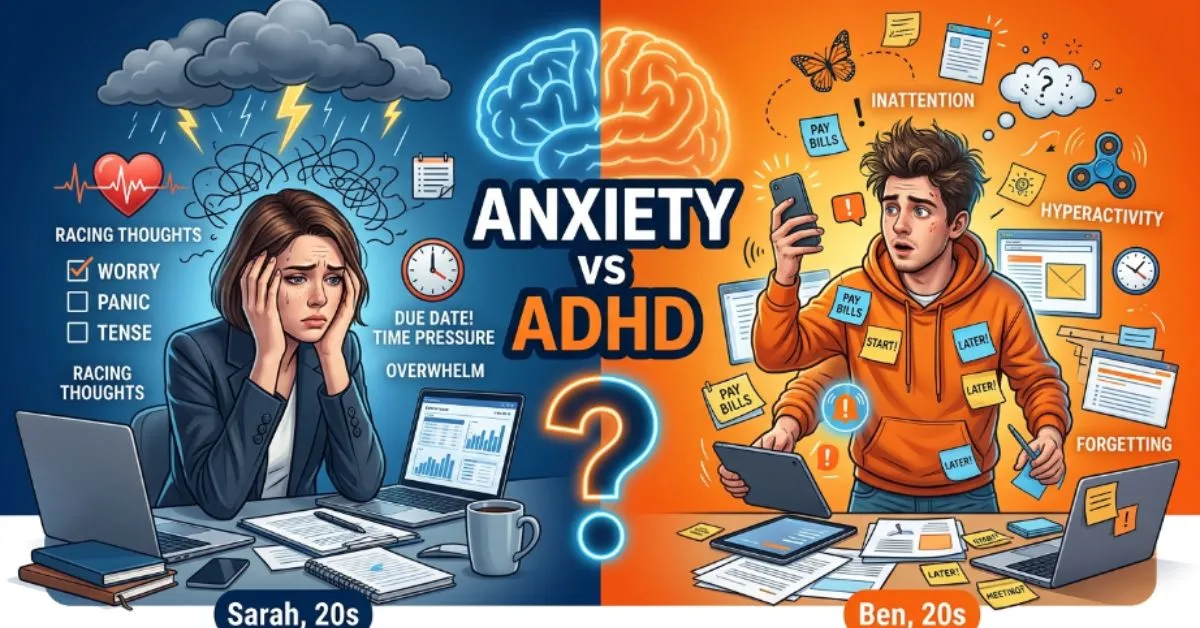
I still remember a time when I couldn’t figure out what was happening to me. Every day, I felt overwhelmed by unfinished tasks. I’d sit down to work, but within minutes, my mind would jump from one thing to another. At the same time, I constantly worried about deadlines, mistakes, and things that hadn’t even happened yet.
At first, I thought it was simply stress. Then I started reading about anxiety and realized many of the symptoms sounded familiar. But the more I researched, the more I came across ADHD. Suddenly, I found myself asking the same question many people ask: Is this anxiety, ADHD, or something else entirely?
What made it even more confusing was that both conditions seemed to share symptoms like poor focus, restlessness, forgetfulness, and racing thoughts. I wasn’t sure which explanation fit best.
To handle the confusion, I began learning how each condition works and what makes them different. That’s when things finally started making sense.
If you’ve ever wondered whether your struggles are caused by anxiety or ADHD, you’re in the right place. In this guide, I’ll break down the differences in a simple way so you can better understand what may be behind these common symptoms.
⚡ Anxiety or ADHD – Quick Answer
Anxiety is a mental health condition centered around excessive worry, fear, and stress.
ADHD (Attention Deficit/Hyperactivity Disorder) is a neurodevelopmental condition that affects attention, impulse control, and executive functioning.
Quick Examples
- Constant worry about future events → Often anxiety.
- Difficulty focusing even when relaxed → Often ADHD.
- Restlessness caused by nervousness → Often anxiety.
- Restlessness present throughout life → Often ADHD.
Simple Rule
Anxiety is usually driven by worry. ADHD is usually driven by attention and executive function challenges.
🤔 Why Do People Compare Anxiety or ADHD?
People compare anxiety and ADHD because the symptoms can look very similar.
Common overlapping symptoms include:
- Difficulty concentrating
- Restlessness
- Sleep problems
- Forgetfulness
- Trouble finishing tasks
- Feeling overwhelmed
Many people assume that poor focus automatically means ADHD.
Others assume constant mental activity must be anxiety.
The truth is that both conditions can affect concentration and productivity, but for different reasons.
Another source of confusion is that anxiety and ADHD can occur together. Many individuals diagnosed with ADHD also experience anxiety symptoms at some point in their lives.
Because of this overlap, professional evaluation is often important when symptoms significantly affect daily functioning.
📜 The Background Behind Both Options
Anxiety
Anxiety has been recognized throughout human history.
Everyone experiences occasional anxiety. However, anxiety disorders involve persistent worry, fear, or nervousness that interferes with daily life.
Common anxiety disorders include:
- Generalized Anxiety Disorder (GAD)
- Social Anxiety Disorder
- Panic Disorder
- Specific Phobias
Today, anxiety disorders are among the most common mental health conditions worldwide.
ADHD
ADHD is a neurodevelopmental condition that typically begins in childhood, though many people are not diagnosed until adulthood.
ADHD affects:
- Attention regulation
- Impulse control
- Organization
- Task management
- Executive functioning
Modern understanding recognizes that ADHD affects both children and adults.
While anxiety centers on fear and worry, ADHD centers on how the brain manages attention and behavior.
📊 Key Differences at a Glance
| Feature | Anxiety | ADHD |
| Main Purpose | Response to perceived threats and worries | Attention and executive function regulation |
| Core Challenge | Excessive worry | Attention and impulsivity |
| Focus Problems | Caused by worry | Caused by attention regulation |
| Restlessness | Driven by nervousness | Driven by hyperactivity or mental stimulation |
| Typical Onset | Can begin at any age | Usually begins in childhood |
| Emotional Impact | Fear, tension, worry | Frustration, overwhelm, impulsivity |
| Best For Understanding | Stress related symptoms | Attention related symptoms |
| Pros | Can increase awareness in small amounts | Often associated with creativity and energy |
| Cons | Can become overwhelming | Can affect organization and productivity |
🔍 Feature by Feature Comparison
Attention and Focus
People with anxiety often struggle to focus because their minds are occupied with worries.
People with ADHD struggle because maintaining attention itself can be difficult.
Racing Thoughts
Both conditions can involve racing thoughts.
With anxiety, thoughts often revolve around fears, problems, and future concerns.
With ADHD, thoughts may jump rapidly between unrelated topics.
Organization
ADHD frequently causes:
- Missed deadlines
- Lost items
- Poor time management
Anxiety may affect organization too, but usually because stress interferes with performance.
Restlessness
Anxiety related restlessness often feels like nervous energy.
ADHD related restlessness often feels like a need for movement or stimulation.
Decision Making
Anxiety may cause overthinking.
ADHD may cause impulsive decisions.
Daily Functioning
Both can affect:
- School
- Work
- Relationships
- Personal goals
The underlying reasons are often different.
💰 Pricing and Value Comparison
Since anxiety and ADHD are health conditions rather than products, costs relate to evaluation and treatment.
Potential expenses may include:
- Medical appointments
- Therapy sessions
- Psychological evaluations
- Coaching services
- Prescription medications
Costs vary significantly based on:
- Location
- Insurance coverage
- Provider type
- Treatment plan
The greatest value comes from obtaining an accurate diagnosis and appropriate support rather than self diagnosing based on symptoms alone.
Pros and Cons ✅❌
Anxiety
Pros
- Can increase awareness of potential risks.
- May encourage preparation and planning.
- Can motivate action in small amounts.
Cons
- Excessive worry.
- Sleep disruption.
- Difficulty relaxing.
- Reduced quality of life when severe.
ADHD
Pros
- Often associated with creativity.
- High energy levels.
- Ability to think outside the box.
- Strong passion for interesting topics.
Cons
- Distractibility.
- Difficulty organizing tasks.
- Impulsivity.
- Time management challenges.
Who Should Choose Anxiety? 🎯
You may relate more to anxiety if you experience:
- ✔ Frequent worrying
- ✔ Fear about future events
- ✔ Physical tension
- ✔ Overthinking
- ✔ Panic symptoms
- ✔ Stress related concentration problems
Common Scenarios
- Worrying about work performance
- Constant concern about health
- Fear of making mistakes
- Excessive stress before events
Who Should Choose ADHD? 🎯
You may relate more to ADHD if you experience:
- ✔ Lifelong attention difficulties
- ✔ Frequent forgetfulness
- ✔ Impulsivity
- ✔ Chronic disorganization
- ✔ Difficulty completing tasks
- ✔ Restlessness without obvious worry
Common Scenarios
- Missing deadlines
- Losing everyday items
- Difficulty staying on task
- Starting many projects but finishing few
❌ Common Mistakes People Make
Mistake #1
Assuming poor focus always means ADHD.
Reality:
Anxiety can significantly impair concentration.
Mistake #2
Assuming worry is always anxiety.
Reality:
Stress, life events, and other factors may contribute.
Mistake #3
Self diagnosing from social media videos.
Reality:
Symptoms often overlap and require professional assessment.
Mistake #4
Ignoring childhood history.
Reality:
ADHD symptoms usually begin early in life.
Mistake #5
Thinking the conditions cannot coexist.
Reality:
Many people experience both ADHD and anxiety.
📝 Real Life Examples
Everyday Situations
A student cannot focus during exams because they worry about failing. Anxiety may be contributing.
Social Media
Many creators discuss ADHD symptoms, causing some viewers to wonder whether their own experiences match.
Reviews
Adults frequently share stories about receiving an ADHD diagnosis after years of believing they only had anxiety.
Professional Discussions
Mental health professionals often evaluate both conditions because symptoms overlap.
Consumer Decisions
People may seek therapy, coaching, or evaluations when symptoms begin affecting work and relationships.
🤔 Things to Consider Before Choosing
Personal Goals
Are symptoms interfering with your daily life?
Long Term Patterns
Have these challenges existed since childhood?
Emotional Experience
Do worries drive the symptoms?
Executive Function
Do organization and planning feel unusually difficult?
Professional Guidance
A qualified healthcare professional can help distinguish between overlapping conditions.
Overall Well Being
The goal isn’t finding a label. The goal is finding helpful support and solutions.
📋 Quick Comparison Table
| Category | Winner |
| Worry and Fear | Anxiety |
| Attention Regulation | ADHD |
| Organization Challenges | ADHD |
| Overthinking | Anxiety |
| Impulsivity | ADHD |
| Stress Response | Anxiety |
| Best for Beginners to Understand | Anxiety |
| Overall Recommendation | Professional Evaluation |
FAQs❓
Q. Is anxiety the same as ADHD?
No. They are separate conditions with different causes and symptoms.
Q. Can anxiety look like ADHD?
Yes. Anxiety can cause concentration and focus problems.
Q. Can ADHD cause anxiety?
Yes. Many people with ADHD experience anxiety symptoms.
Q. Which is more common?
Both are common, but prevalence varies depending on age and population.
Q. Can adults have ADHD?
Yes. ADHD affects both children and adults.
Q. Is overthinking a sign of ADHD?
It can occur in ADHD, but it is more commonly associated with anxiety.
Q. Can you have both anxiety and ADHD?
Yes. Co occurring symptoms are common.
Q. What is the biggest difference?
Anxiety is centered on worry. ADHD is centered on attention and executive function.
Q. How do doctors tell them apart?
They evaluate symptoms, history, behavior patterns, and functional impact.
Q. Should I self diagnose?
Professional evaluation is the most reliable way to understand symptoms.
Expert Tip 💡
Ask yourself one simple question:
“When I can’t focus, is it because I’m worried about something, or because my attention keeps drifting?”
The answer won’t provide a diagnosis, but it may help you understand whether anxiety or ADHD symptoms seem more connected to your experience.
Conclusion
The comparison between anxiety or ADHD is more complex than many people realize. Both conditions can affect concentration, productivity, sleep, relationships, and overall quality of life. Because the symptoms often overlap, confusion is common.
Anxiety is primarily driven by fear, worry, and stress. ADHD is primarily related to attention regulation, impulse control, and executive functioning. While they can appear similar on the surface, the underlying causes are often very different.
One important fact to remember is that anxiety and ADHD are not mutually exclusive. Many individuals experience symptoms of both conditions, which can make self diagnosis difficult.
Instead of focusing on finding the “right label,” focus on understanding your experiences, identifying patterns, and seeking appropriate support when symptoms interfere with daily life.
If worries dominate your thoughts, anxiety may be playing a larger role. If lifelong attention and organization challenges have been present, ADHD may deserve consideration.
The most effective path forward is accurate information, professional guidance, and a willingness to explore what truly fits your situation. Understanding the difference is often the first step toward meaningful improvement.

I’m Veronica Roth, an author at GrammarGuides.com, where I make English easy to understand. As a grammar expert, I help readers master spelling, punctuation, and common language mistakes.