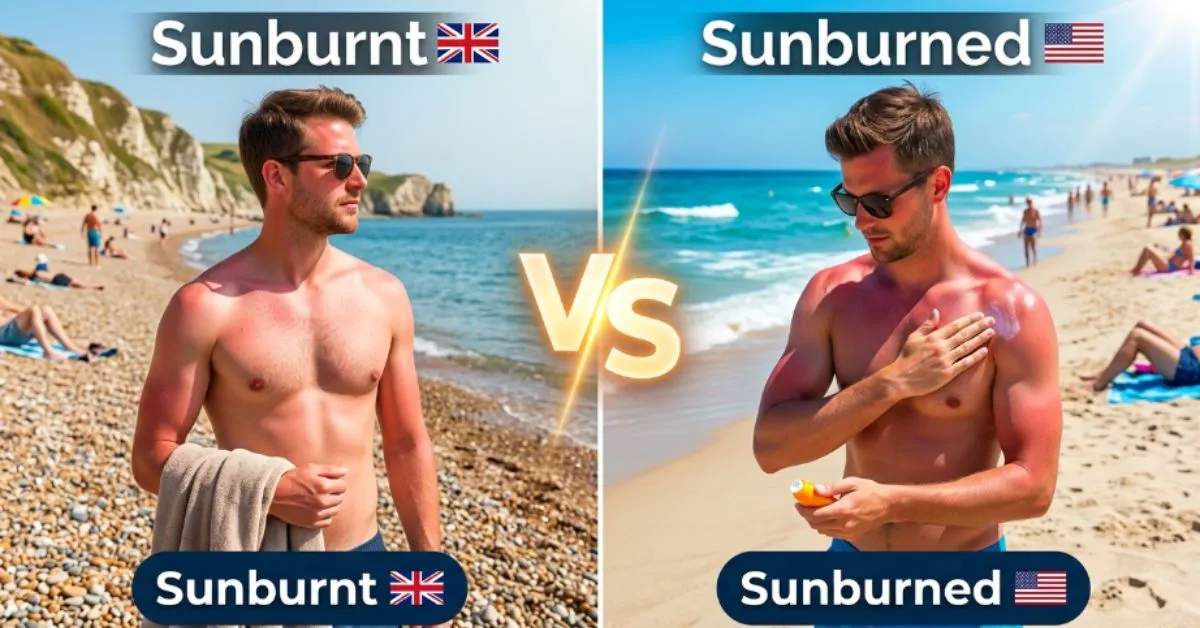
I still remember coming back from a beach trip on a hot summer afternoon. My skin was bright red, my shoulders felt like they were on fire, and even wearing a simple T-shirt was uncomfortable. When I tried explaining it to a friend, I said, “I’m completely sunburnt.”
A few minutes later, someone else said the correct term was actually “sunburned.” That small conversation left me surprisingly confused.
I started wondering whether sunburnt and sunburned meant the same thing or if one was more correct than the other. The more I looked into it, the more I realized that many people, especially writers, students, and travelers, ask the same question. Both words appear in books, articles, and everyday conversations, making it difficult to know which one to use.
If you’ve ever paused while writing an email, social media post, or article and wondered whether to choose sunburnt or sunburned, you’re not alone. The good news is that the answer is much simpler than most people think.
In this guide, I’ll explain the difference, when to use each word, and the simple rule that makes choosing the right one easy every time.
⚡ Sunburnt or Sunburned – Quick Answer
Both sunburnt and sunburned are correct.
- Sunburned is more common in American English.
- Sunburnt is more common in British English.
Examples
- I got sunburned at the beach yesterday.
- My arms look sunburnt after the hike.
- She became badly sunburned during vacation.
Simple Rule
If you’re writing for a U.S. audience, sunburned is usually the safer choice.
🤔 Why Do People Compare Sunburnt or Sunburned?
People compare these words because:
- Both describe skin damaged by sunlight.
- Both appear in dictionaries.
- Both are grammatically correct.
- Different countries prefer different versions.
Many people assume one word must be wrong.
The reality is that both are acceptable. The difference is mostly based on language preference and regional usage.
Someone in the United States is more likely to say sunburned, while someone in the United Kingdom may naturally use sunburnt.
📜 The Background Behind Both Options
The word “sunburn” has existed for centuries.
As English evolved, many verbs developed two past participle forms:
- Burned / Burnt
- Learned / Learnt
- Dreamed / Dreamt
Sunburned
Sunburned follows the American English preference for ed endings.
Examples:
- burned
- learned
- spoiled
Sunburnt
Sunburnt follows the traditional British English preference for t endings.
Examples:
- burnt
- learnt
- spoilt
Today, both forms remain widely accepted.
📊 Key Differences at a Glance
| Feature | Sunburnt | Sunburned |
| Main Purpose | Describes skin damaged by sun | Describes skin damaged by sun |
| Meaning | Same meaning | Same meaning |
| American English | Less common | More common |
| British English | More common | Less common |
| Formal Writing | Accepted | Accepted |
| Everyday Conversation | Common in UK | Common in US |
| Best For | British audiences | American audiences |
| Pros | Traditional style | Familiar to U.S. readers |
| Cons | May sound unusual in US | Less common in UK |
🔍 Feature by Feature Comparison
Meaning
There is no difference in meaning.
Both words describe skin that has been damaged by excessive exposure to the sun.
Regional Preference
This is the biggest distinction.
Sunburned dominates in American English.
Sunburnt appears more frequently in British English, Australian English, and some Commonwealth countries.
Professional Writing
Medical professionals use both forms depending on location and style guides.
American publications generally favor sunburned.
Reader Expectations
U.S. readers often expect sunburned.
British readers often find sunburnt more natural.
SEO and Content Writing
For websites targeting American traffic, sunburned may align better with user expectations.
However, both terms are searchable and understood.
💰 Pricing and Value Comparison
Since sunburnt and sunburned are words rather than products or services, there is no direct cost comparison.
However, using the version preferred by your audience provides value through:
- Better readability
- Stronger audience connection
- More natural communication
- Improved user experience
For U.S. focused content, the value often lies in choosing sunburned.
Pros and Cons ✅❌
Sunburnt
Pros
- Correct English usage.
- Common in British English.
- Traditional sounding.
- Widely recognized.
Cons
- Less familiar to some American readers.
- Can appear unusual in U.S. publications.
Sunburned
Pros
- Preferred in American English.
- Common in healthcare content.
- Familiar to U.S. readers.
- Easy to understand.
Cons
- Less common in some British contexts.
- May sound less traditional to UK readers.
Who Should Choose Sunburnt? 🎯
Use sunburnt if you:
- ✔ Write primarily for British readers
- ✔ Follow British spelling conventions
- ✔ Create content for UK, Australia, or New Zealand
- ✔ Prefer traditional English usage
Example
“The tourists returned home feeling sunburnt after a day at the coast.”
Who Should Choose Sunburned? 🎯
Use sunburned if you:
- ✔ Write for an American audience
- ✔ Publish U.S. focused content
- ✔ Create healthcare articles
- ✔ Write travel or lifestyle blogs in American English
Example
“The children became sunburned after swimming all afternoon.”
❌ Common Mistakes People Make
Mistake #1
Thinking one word is wrong.
Reality:
Both are correct.
Mistake #2
Mixing spelling styles in one article.
Example:
Incorrect:
“He was sunburned yesterday and looks sunburnt today.”
Choose one style and stay consistent.
Mistake #3
Assuming sunburnt sounds more formal.
Reality:
The choice is mainly regional.
Mistake #4
Using the wrong audience preference.
American readers generally expect sunburned.
📝 Real Life Examples
Everyday Situations
“I got sunburned during the baseball game.”
Social Media
“Feeling sunburnt after spending all day outside.”
Reviews
“The sunscreen worked well and prevented me from getting sunburned.”
Professional Discussions
“The patient showed signs of mild sunburned skin.”
Consumer Decisions
Travelers often read product reviews about preventing sunburned or sunburnt skin during vacations.
🤔 Things to Consider Before Choosing
Audience
American readers usually prefer sunburned.
Writing Style
Match the spelling style used throughout your content.
Consistency
Don’t switch between versions in the same article.
Personal Preference
Either option is acceptable if it matches your audience.
Long Term Value
Consistent language builds trust and professionalism.
📋 Quick Comparison Table
| Category | Winner |
| American English | Sunburned |
| British English | Sunburnt |
| Everyday U.S. Usage | Sunburned |
| Traditional Style | Sunburnt |
| Best for Beginners | Sunburned |
| Best Overall Value (US) | Sunburned |
| Best Convenience | Sunburned |
| Overall Recommendation | Depends on audience |
FAQs❓
Q. Is sunburnt a real word?
Yes. It is a correct English word.
Q. Is sunburned correct?
Yes. It is also correct.
Q. Which is more common in America?
Sunburned.
Q. Which is more common in Britain?
Sunburnt.
Q. Do sunburnt and sunburned mean the same thing?
Yes.
Q. Can I use either word?
Yes, but choose the version preferred by your audience.
Q. Is sunburnt old fashioned?
Not necessarily. It remains common in British English.
Q. Which version should bloggers use?
Use the spelling that matches your target audience.
Q. Do dictionaries accept both forms?
Yes.
Q. Which word is better for SEO?
For U.S. audiences, sunburned may be slightly more natural.
Expert Tip 💡
Think about your audience before choosing.
If your readers are primarily in the United States, use sunburned. If your readers are in the United Kingdom, sunburnt may feel more natural.
The key is consistency.
Conclusion
The debate over sunburnt or sunburned is much simpler than many people expect. Unlike some grammar questions where one choice is clearly wrong, both of these words are accepted and widely understood in modern English.
The real difference comes down to regional preference. Sunburned is the form most commonly used in American English, while sunburnt appears more frequently in British English and other Commonwealth countries. Their meanings are identical, and both accurately describe skin that has been damaged by too much exposure to the sun.
For most writers, the best choice depends on the audience they want to reach. If you’re creating content for U.S. readers, using sunburned will usually feel more natural and familiar. If you’re writing for a British audience, sunburnt may be the better fit.
The most important thing is consistency. Choose one version and use it throughout your writing. Doing so makes your content look polished, professional, and easy to read.
The next time you come home from a sunny vacation with red skin and a lesson about sunscreen, you’ll know exactly which word fits your audience and why.

I’m David Mitchell, an author at GrammarGuides.com where I help readers understand English more clearly. As a grammar expert, I share simple explanations and tips to fix common spelling and grammar mistakes.