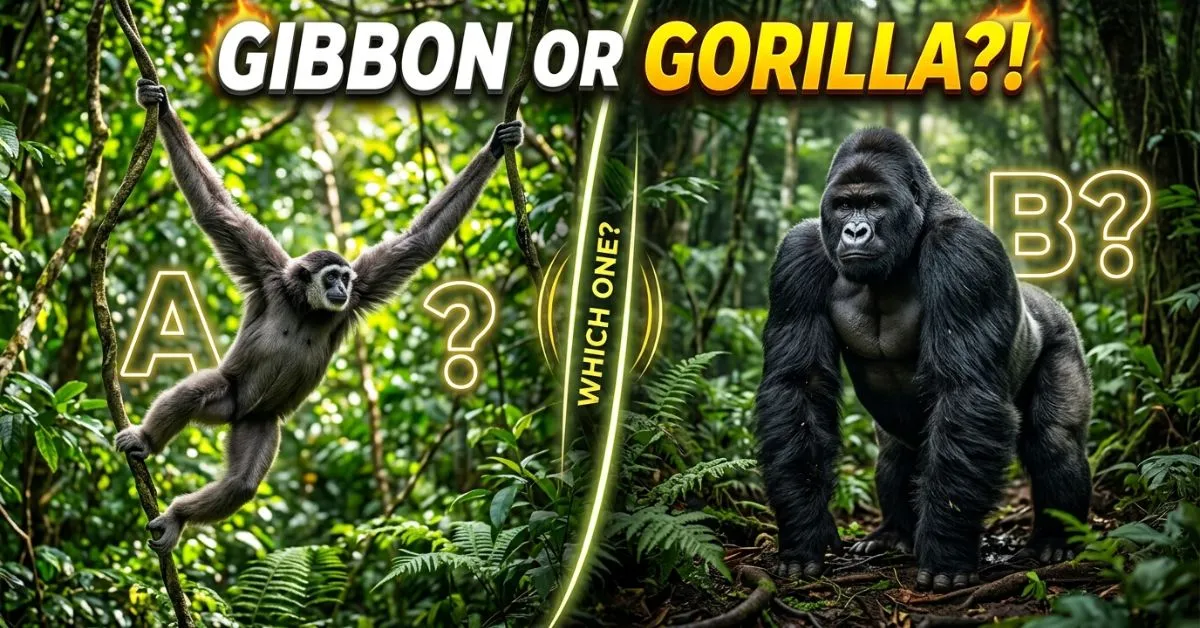
I still remember the moment I embarrassed myself at the zoo. I pointed at a long armed animal swinging across ropes and confidently told my friend, “Look at that gorilla!” A few seconds later, my friend started laughing. “That’s not a gorilla,” he said. “It’s a gibbon.” Honestly, I was shocked. To me, all large monkeys and apes looked almost the same. They had fur, long arms, and lived in trees. I thought “gibbon” was just another name for a gorilla.
But once I started searching online for “gibbon or gorilla,” the confusion only got worse. Some photos showed tiny swinging apes. Others showed giant muscular gorillas. Then I discovered something surprising: Gibbons and gorillas are both apes but they are incredibly different in size, behavior, habitat, and appearance.
If you’ve ever mixed up a gibbon and a gorilla, you are definitely not alone. Many people confuse them because both belong to the ape family and often appear in wildlife documentaries and zoo videos together. The good news? Once you learn a few simple differences, telling them apart becomes extremely easy.
In this guide, I’ll explain the real difference between gibbon or gorilla, why people confuse them, where the names came from, and the easiest tricks to identify them quickly. By the end, you’ll never mix them up again.
⚡ Gibbon or Gorilla – Quick Answer
A gibbon is a small, lightweight ape famous for swinging through trees using long arms. A gorilla is a massive ground dwelling ape known for strength and muscular bodies.
Quick Examples:
- Small swinging ape in trees = likely a gibbon
- Huge muscular ape on the ground = likely a gorilla
- Gibbons are much smaller than gorillas
🤔 Why Do People Confuse Gibbon or Gorilla?
People confuse gibbons and gorillas because both animals belong to the ape family.
They also:
- have human like faces,
- long arms,
- expressive behavior,
- and no tails.
To beginners, many apes look similar at first glance.
Movies, cartoons, and social media increase the confusion even more. Many people casually call all apes “gorillas,” even when they are completely different species.
The biggest difference is body size and movement.
Gibbons Usually:
- are small,
- move quickly through trees,
- and swing using long arms.
Gorillas Usually:
- are extremely large,
- walk mostly on the ground,
- and move with powerful knuckle walking.
Once you notice size and movement style, the difference becomes much clearer.
📜 The Origin of Gibbon or Gorilla
The word gibbon likely came from French usage during early studies of Asian apes. Gibbons are native mainly to Southeast Asia and are famous for their loud songs and tree swinging skills.
The word gorilla comes from ancient Greek records describing hairy wild people in Africa. Over time, scientists used the name for the world’s largest living apes.
Unlike spelling confusion topics such as “color vs colour,” gibbon and gorilla are completely different animal names.
Today:
- gibbons are known for agility and swinging,
- while gorillas are known for power and strength.
🌍 British vs American English
There is no spelling difference between British and American English for these words.
Both regions use:
- Gibbon
- Gorilla
Comparison Table
| Word | American English | British English | Meaning |
| Gibbon | Gibbon | Gibbon | Small tree swinging ape |
| Gorilla | Gorilla | Gorilla | Large powerful ape |
The spelling remains identical worldwide.
🎯 Which One Should You Use?
Use “Gibbon” When:
- discussing small apes,
- talking about tree swinging,
- or describing Southeast Asian apes.
Use “Gorilla” When:
- discussing massive apes,
- talking about silverbacks,
- or describing African great apes.
For Bloggers and SEO Writers
Correct terminology matters because readers search for very different information.
Someone searching:
- “gibbon facts”
usually wants information about: - swinging,
- rainforest life,
- and smaller apes.
Someone searching:
- “gorilla behavior”
usually wants: - strength facts,
- social groups,
- or wildlife documentaries.
Using accurate wording improves:
- SEO performance,
- reader trust,
- and content clarity.
For Freelancers and Content Creators
Wildlife and zoo content becomes much more professional when animal species are identified correctly.
❌ Common Mistakes (Avoid These!)
Many people accidentally misuse gibbon and gorilla terms.
Mistake #1: Calling Every Ape a Gorilla
❌ Wrong: “That tiny swinging gorilla looks cute.”
✅ Correct: “That’s actually a gibbon.”
Mistake #2: Thinking Gibbons Are Monkeys
❌ Wrong: “Gibbons are monkeys with no tails.”
✅ Correct: “Gibbons are apes, not monkeys.”
Mistake #3: Ignoring Body Size
❌ Wrong: “Gibbons and gorillas are about the same size.”
✅ Correct: “Gorillas are dramatically larger.”
Mistake #4: Confusing Habitat Regions
❌ Wrong: “Gibbons live in African jungles.”
✅ Correct: “Gibbons mainly live in Asia.”
Mistake #5: Misunderstanding Movement
❌ Wrong: “Gorillas swing through trees like gibbons.”
✅ Correct: “Gibbons swing more frequently and skillfully.”
📝 Real Life Examples
Here’s how gibbon and gorilla are used correctly in everyday writing.
Emails
- “The zoo recently added two rescued gibbons.”
- “The gorilla habitat reopened this weekend.”
Social Media
- “Watching gibbons swing through trees is amazing.”
- “That silverback gorilla looks incredibly powerful.”
News and Wildlife Content
- “Gibbon populations face habitat loss in Southeast Asia.”
- “Gorilla conservation remains critical in Africa.”
Formal Writing
- “Gibbons use brachiation for rapid tree movement.”
- “Gorillas live in complex family groups led by silverbacks.”
🔍 Gibbon vs Gorilla: The Main Difference
Here’s the easiest way to remember the difference.
| Feature | Gibbon | Gorilla |
| Size | Small | Very large |
| Habitat | Trees/rainforests | Ground/forests |
| Region | Asia | Africa |
| Movement | Swinging | Knuckle walking |
| Body Type | Slim and light | Muscular and heavy |
| Sound | Loud songs | Deep vocal sounds |
| Tail | No | No |
This comparison makes identification much easier.
🌳 Why Gibbons Are So Unique
Gibbons are famous for something called:
- brachiation.
That means they swing from branch to branch using incredibly long arms.
They are among the fastest tree moving mammals on Earth.
Gibbons are also known for:
- loud singing calls,
- family bonding,
- and agile movement.
Many people describe them as the “acrobats of the rainforest.”
Because they move so differently from gorillas, they become easier to recognize once you know what to watch for.
🦍 Why Gorillas Fascinate People
Gorillas are the largest living primates in the world.
People admire them because of their:
- enormous strength,
- intelligence,
- and human like emotions.
Despite their scary appearance, gorillas are often calm and gentle unless threatened.
They usually live in family groups led by:
- dominant males called silverbacks.
Movies and documentaries helped make gorillas one of the most recognizable animals worldwide.
📊 Quick Comparison Table
| Term | Meaning | Category | Common Usage | Region |
| Gibbon | Small swinging ape | Animal | Rainforests, wildlife | Asia |
| Gorilla | Large powerful ape | Animal | Zoos, documentaries | Africa |
FAQs ❓
Q. Is a gibbon a gorilla?
No. Gibbons and gorillas are different ape species.
Q. Are gibbons monkeys?
No. Gibbons are apes, not monkeys.
Q. Which is bigger: gibbon or gorilla?
Gorillas are much larger and heavier.
Q. Do gorillas swing through trees?
Young gorillas may climb trees, but they do not swing like gibbons.
Q. Where do gibbons live?
Mostly in Southeast Asian rainforests.
Q. Are gorillas dangerous?
Gorillas can be dangerous if threatened, but they are usually calm animals.
Q. Why do gibbons have long arms?
Their long arms help them swing quickly between trees.
Q. Do both animals have tails?
No. Neither gibbons nor gorillas have tails.
Conclusion
Understanding the difference between gibbon or gorilla becomes very simple once you focus on size, movement, and habitat.
Gibbons are:
- small,
- lightweight,
- tree swinging apes from Asia.
Gorillas are:
- massive,
- muscular,
- ground dwelling apes from Africa.
People often confuse them because both belong to the ape family and share human like features. But once you notice:
- swinging versus knuckle walking,
- slim bodies versus huge muscles,
- and Asia versus Africa,
the confusion disappears quickly.
The easiest trick to remember is this:
- small swinging ape = gibbon,
- giant powerful ape = gorilla.
Now, the next time you visit a zoo or watch a wildlife documentary, you’ll instantly know exactly which ape you’re looking at.
And you’ll never confuse gibbon and gorilla again.
Discover More Articles:
- Envelop or Envelope : Noun vs Verb Explained Simply✍️
- 🔥 Grill or Grille : The Surprising Truth Hidden in BBQ Menus and Car Ads
- 🍲 Ladel or Ladle : The Fastest Way to Remember the Correct Spelling

I’m Dan Brown, an author behind GrammarGuides.com, where I share simple tips to help people write English clearly and correctly. As a grammar expert, I enjoy explaining tricky words, spelling differences, and common language mistakes in an easy way.