I still remember sitting in a meeting where a manager used the phrase “change or die.” At first, I thought it sounded dramatic. Surely things weren’t that serious. After all, people and businesses don’t literally die because they refuse to change, right?
A few years later, I started noticing the phrase everywhere. Companies used it when talking about innovation. Health experts used it when discussing lifestyle choices. Career coaches mentioned it when explaining workplace success. The more I heard it, the more curious I became about what it really meant.
Many people compare the words change and die because they often appear together as a powerful warning. The phrase suggests that staying the same can sometimes be more dangerous than trying something new. Yet people often misunderstand the message and assume it only applies to businesses or major life decisions.
The real question most people are trying to answer is simple: When is change necessary, and what happens if we refuse it?
If you’ve ever wondered why “change or die” has become such a popular phrase, this guide will explain its meaning, origins, practical applications, and the lessons it offers for everyday life in a clear and easy-to-understand way.
⚡Change or Die – Quick Answer
Change means adapting, improving, or moving in a new direction.
Die in the phrase “change or die” usually means becoming irrelevant, failing, or losing opportunities because of resistance to change.
Quick Examples
- A business adopts new technology = Change.
- A business ignores industry trends and loses customers = Die.
- A person improves unhealthy habits = Change.
Simple Takeaway Rule
If circumstances evolve and you refuse to adapt, you risk falling behind.
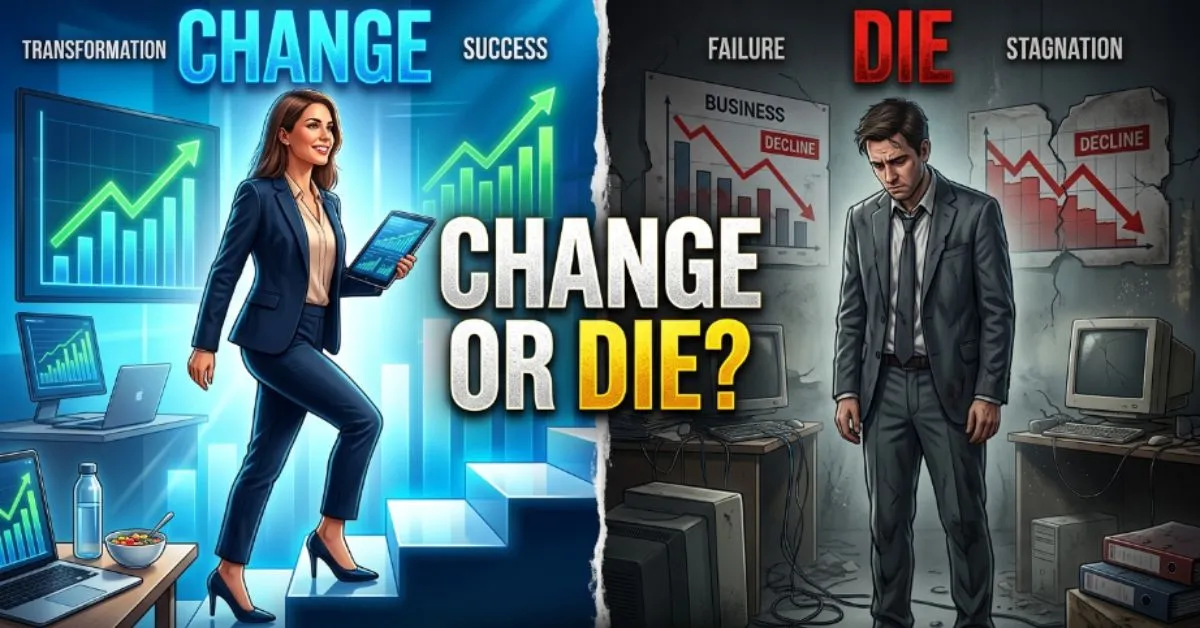
🤔 Why Do People Compare Change or Die?
People compare these concepts because they are presented as opposites.
The phrase creates a strong contrast:
- Change represents growth.
- Die represents decline.
- One suggests progress.
- The other suggests failure.
Many people assume the phrase is extreme. However, its purpose is to highlight the consequences of refusing necessary adaptation.
The confusion comes from taking the phrase literally instead of understanding it as a metaphor.
📜 The Background Behind Both Options
The Meaning of Change
Change has always been part of human life.
People change jobs, habits, technology, businesses, and lifestyles. Societies evolve because people adapt to new challenges and opportunities.
The Meaning of Die in This Context
In the phrase “change or die,” die is often symbolic.
It can mean:
- Losing relevance
- Losing customers
- Losing opportunities
- Falling behind competitors
- Failing to achieve goals
Today, the phrase is commonly used in business, health, education, leadership, and personal development.
📊 Key Differences at a Glance
| Feature | Change | Die |
| Main Purpose | Adapt and improve | Result of failing to adapt |
| Meaning | Growth and evolution | Decline or failure |
| Outcome | New opportunities | Missed opportunities |
| Flexibility | High | None |
| Long-Term Impact | Positive potential | Negative consequences |
| Availability | Always possible | Often avoidable |
| Convenience | Requires effort | May seem easier initially |
| Best For | Progress and survival | Not a desired choice |
| Pros | Learning, growth, success | None in most contexts |
| Cons | Uncertainty and discomfort | Loss and stagnation |
🔍 Feature by Feature Comparison
Adaptability
Change encourages flexibility.
People who adapt can respond to new situations more effectively.
Die represents a lack of adaptation and growth.
Opportunity
Change often creates opportunities.
Learning new skills, adopting technology, or improving habits can open new doors.
Failure to change can close opportunities over time.
Comfort Level
Many people resist change because it feels uncomfortable.
Remaining the same feels safe at first.
However, long-term comfort can sometimes create long-term problems.
Risk
Change involves uncertainty.
Yet refusing change can sometimes be the greater risk.
Future Readiness
Change prepares individuals and organizations for the future.
Refusing change often leaves them unprepared.
💰 Pricing and Value Comparison
Although change and die are not products, both involve costs and consequences.
The Cost of Change
May include:
- Time
- Effort
- Training
- Learning new skills
- Temporary discomfort
The Cost of Not Changing
May include:
- Lost income
- Lost opportunities
- Reduced competitiveness
- Poor health outcomes
- Career stagnation
Which Offers Better Value?
In most situations, investing in positive change provides greater long-term value than remaining stuck in outdated habits or systems.
Remember that circumstances vary, and decisions should be based on individual goals and needs.
Pros and Cons ✅❌
Change Pros
- Encourages growth
- Creates opportunities
- Improves adaptability
- Supports innovation
- Helps solve problems
Change Cons
- Can feel uncomfortable
- Requires effort
- May involve risk
- Results are not always immediate
Die Pros
- None in the context of the phrase
Die Cons
- Lost opportunities
- Reduced relevance
- Stagnation
- Competitive disadvantage
- Potential failure
Who Should Choose Change? 🎯
Change is ideal for people who:
✔ Want personal growth
✔ Need career advancement
✔ Are facing new challenges
✔ Want healthier habits
✔ Seek long-term success
✔ Need to stay competitive
Best Scenarios
- Learning new skills
- Starting a business
- Improving health habits
- Adapting to technology
- Career development
Who Ends Up Facing the “Die” Outcome? 🎯
This outcome often affects people or organizations that:
✔ Ignore changing markets
✔ Refuse to learn
✔ Reject innovation
✔ Resist necessary improvements
✔ Depend entirely on outdated methods
Common Scenarios
- Businesses losing customers
- Workers refusing new skills
- Organizations ignoring industry trends
- Individuals avoiding important lifestyle changes
❌ Common Mistakes People Make
Mistake #1: Thinking Change Means Starting Over
Reality: Change often involves improvement, not complete replacement.
Mistake #2: Assuming Change Must Be Massive
Reality: Small changes can create major results over time.
Mistake #3: Believing Stability Means No Change
Reality: Long-term stability often requires continuous adaptation.
Mistake #4: Waiting Too Long
Reality: Delaying necessary change can make future adjustments harder.
Mistake #5: Taking the Phrase Literally
Reality: “Die” is usually a metaphor for decline or failure.
📝 Real Life Examples
Everyday Situations
A person starts exercising after years of inactivity.
That’s change.
Ignoring serious health warnings may lead to negative consequences.
Social Media
Creators adapt to new algorithms and content trends.
Those who refuse often lose engagement.
Reviews
Businesses that listen to customer feedback often improve.
Companies that ignore reviews may struggle.
Professional Discussions
Workers who learn new technology remain competitive.
Those who avoid learning may find fewer opportunities.
Consumer Decisions
Brands that innovate often attract customers.
Brands that stop improving may lose market share.
🤔 Things to Consider Before Choosing
Budget
Some changes require financial investment.
Consider whether the benefits justify the cost.
Long Term Value
Focus on future benefits rather than short-term comfort.
Ease of Use
Some changes are easier to implement than others.
Start small when possible.
Personal Goals
Ask yourself:
- What do I want to achieve?
- What challenges am I facing?
- What skills do I need?
Features Needed
Consider:
- Flexibility
- Growth opportunities
- Sustainability
- Long-term success
Important Deciding Factors
The most important question is:
Will staying the same help or hurt my future goals?
📋 Quick Comparison Table
| Category | Winner |
| Best for Beginners | Change |
| Best Long-Term Value | Change |
| Best Career Growth | Change |
| Best Personal Growth | Change |
| Best Adaptability | Change |
| Best Future Readiness | Change |
| Overall Recommendation | Change |
FAQs❓
Q. What does change or die mean?
It means adapting to new circumstances or risking failure and decline.
Q. Is change or die a literal phrase?
Usually no. It is commonly used as a metaphor.
Q. Why is change important?
Change helps people and organizations grow, improve, and stay relevant.
Q. Who uses the phrase change or die?
Business leaders, educators, health experts, and motivational speakers often use it.
Q. Can small changes make a big difference?
Yes. Consistent small improvements often create significant long-term results.
Q. Does change always lead to success?
Not always, but refusing necessary change can increase risk.
Q. Is the phrase only about business?
No. It can apply to health, careers, relationships, and personal development.
Q. Why do people resist change?
Fear, uncertainty, comfort, and habit are common reasons.
Q. How can I become more adaptable?
Start learning new skills, stay curious, and remain open to feedback.
Q. Is every change good?
No. Effective change should align with your goals and circumstances.
Expert Tip 💡
Don’t wait for a crisis before making improvements. The best time to adapt is often before change becomes unavoidable. Small, consistent adjustments are usually easier and more effective than large emergency reactions.
Conclusion
The phrase change or die may sound dramatic, but its message is surprisingly practical. It reminds us that growth, adaptation, and learning are often necessary for long-term success. Whether we’re talking about businesses, careers, health, technology, or personal development, the ability to adjust to changing circumstances can make a huge difference.
Change is rarely easy. It often requires effort, patience, and a willingness to step outside your comfort zone. However, those temporary challenges are usually far less costly than the consequences of refusing to adapt. Staying exactly the same may feel safe today, but it can create problems tomorrow if the world around you continues to evolve.
That doesn’t mean every change is good. Smart decisions require careful thinking and clear goals. The key is to recognize when adaptation is necessary and to take action before opportunities disappear.
For most people and organizations, the better path is clear. Focus on meaningful improvements, embrace learning, and remain open to new possibilities. In the long run, thoughtful change is often the strongest strategy for growth, success, and resilience.
Disclaimer
This article is for informational and educational purposes only. Personal, business, health, and financial decisions should be based on your individual circumstances and professional advice when appropriate.