I still remember reading an email from a coworker that said, “The new training program was very affective.” At first, I paused. Something felt wrong, but I couldn’t immediately explain why.
Later, I realized they had confused affective with effective, a mistake that many English speakers make every day. The two words look almost identical. They sound similar. Yet their meanings are completely different.
This confusion shows up in school papers, business reports, social media posts, marketing materials, and even professional presentations. One word relates to emotions and feelings, while the other refers to success and results. Using the wrong one can completely change the meaning of a sentence.
If you’ve ever wondered whether to write affective or effective, you’re not alone. Thousands of people search for this comparison because they want to communicate clearly and avoid embarrassing mistakes.
The good news? The difference is actually much simpler than it seems. In this guide, I’ll explain exactly what each word means, when to use it, common mistakes to avoid, and a simple trick that will help you remember the difference forever.
⚡Affective or Effective – Quick Answer
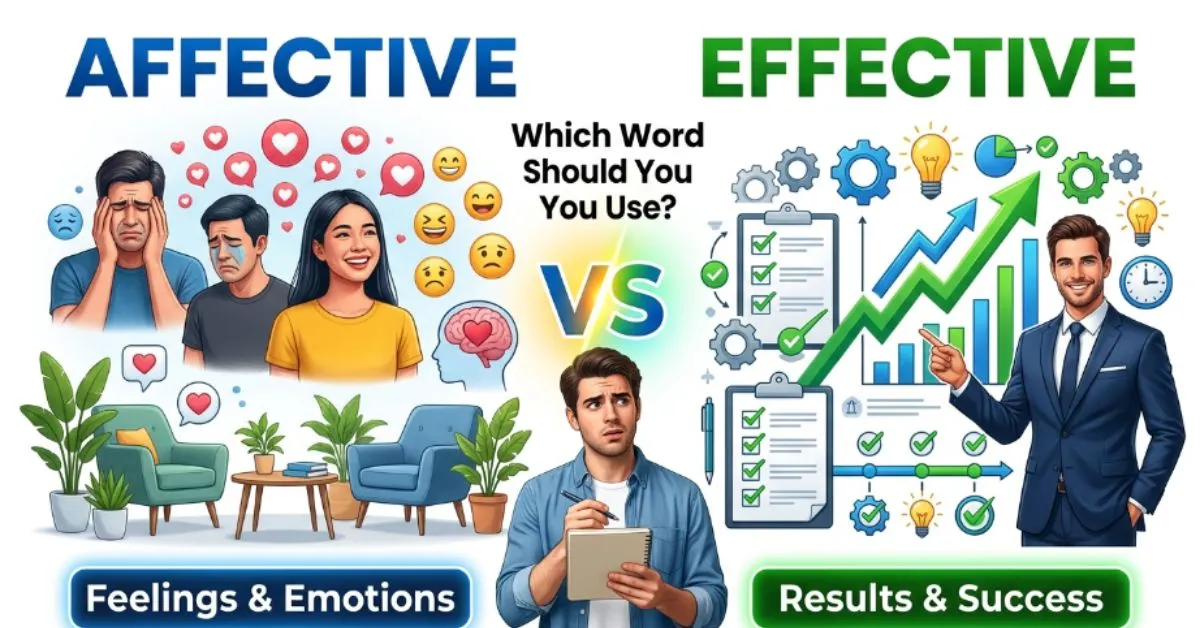
Affective relates to emotions, feelings, moods, or emotional responses.
Effective means successful, useful, or able to produce the desired result.
Examples
- The therapist studied affective behavior in patients.
- The medicine was highly effective.
- The movie created a strong affective response.
Simple Rule
Affective = Affects feelings.
Effective = Produces effects or results.
🤔 Why Do People Compare Affective or Effective?
People compare these words because they:
- Look nearly identical.
- Sound similar when spoken quickly.
- Are both commonly used in professional writing.
- Appear in education, psychology, healthcare, and business.
Many people assume the words are interchangeable. They are not.
The confusion becomes even greater because both words share a connection to the word effect, making their meanings seem related at first glance.
A common assumption is:
Wrong: Affective means successful.
Correct: Effective means successful.
Another common mistake:
Wrong: Effective relates to emotions.
Correct: Affective relates to emotions.
📜 The Background Behind Both Options
Affective
The word affective comes from the Latin root affectus, meaning emotion, feeling, or mental state.
Today, it is primarily used in:
- Psychology
- Psychiatry
- Education
- Behavioral sciences
It describes emotional experiences and responses.
Effective
The word effective comes from the Latin effectivus, meaning productive or capable of producing results.
Today, it is widely used in:
- Business
- Marketing
- Healthcare
- Education
- Everyday communication
It refers to something that works successfully.
Although the words share similar roots, their modern meanings are very different.
📊 Key Differences at a Glance
| Feature | Affective | Effective |
| Main Purpose | Describes emotions | Describes success or results |
| Meaning | Related to feelings | Produces desired outcomes |
| Common Fields | Psychology, education | Business, healthcare, daily life |
| Frequency of Use | Less common | Very common |
| Availability in Everyday Speech | Limited | Frequent |
| Convenience | Specialized term | General use term |
| Best For | Discussing emotional responses | Discussing performance and success |
| Pros | Precise emotional meaning | Easy to understand |
| Cons | Often misunderstood | Frequently confused with affective |
Feature by Feature Comparison 🔍
Meaning
Affective focuses on emotional experiences.
Example:
“The child showed strong affective reactions to music.”
Effective focuses on results.
Example:
“The teaching method was effective.”
Usage
Affective appears mostly in academic and scientific contexts.
Effective appears in everyday conversations and professional communication.
Audience Understanding
Most people instantly understand effective.
Affective often requires additional explanation unless the audience is familiar with psychology.
Practical Application
Use affective when discussing:
- Feelings
- Emotions
- Mood
- Emotional behavior
Use effective when discussing:
- Success
- Performance
- Results
- Efficiency
💰 Pricing and Value Comparison
Since affective and effective are words rather than products or services, there is no direct pricing comparison.
However, their value comes from choosing the correct word.
Using the wrong term may:
- Reduce credibility
- Create confusion
- Make writing appear unprofessional
Using the correct term improves:
- Clarity
- Professional communication
- Reader understanding
In terms of communication value, knowing the difference is extremely valuable.
Pros and Cons ✅❌
Affective
Pros
- Precisely describes emotional experiences.
- Useful in psychology and education.
- Adds accuracy to academic writing.
Cons
- Less familiar to general readers.
- Easily confused with effective.
- Limited everyday use.
Effective
Pros
- Widely understood.
- Useful across many industries.
- Clearly communicates success.
Cons
- Frequently misspelled.
- Often confused with affective.
- Can be overused in business writing.
Who Should Choose Affective? 🎯
Use affective if your writing involves:
- ✔ Psychology
- ✔ Mental health
- ✔ Emotional development
- ✔ Behavioral science
- ✔ Human emotions
- ✔ Educational research
Example Scenarios
- Research papers
- Therapy discussions
- Academic studies
- Emotional intelligence training
Who Should Choose Effective? 🎯
Use effective if your writing involves:
- ✔ Business communication
- ✔ Marketing campaigns
- ✔ Workplace reports
- ✔ Product reviews
- ✔ Healthcare treatments
- ✔ Everyday conversations
Example Scenarios
- “This strategy is effective.”
- “The medication was effective.”
- “The advertisement was effective.”
❌ Common Mistakes People Make
Mistake #1
Incorrect: The new software is affective.
Correct: The new software is effective.
Why?
Software produces results, not emotions.
Mistake #2
Incorrect: The study examined effective responses to stress.
Correct: The study examined affective responses to stress.
Why?
Stress responses often involve emotions.
Mistake #3
Assuming both words mean the same thing.
Reality:
- Affective = feelings
- Effective = results
Mistake #4
Choosing affective because it sounds more formal.
Reality:
Formal doesn’t always mean correct.
📝 Real Life Examples
Everyday Situations
Correct:
“This cleaning product is effective.”
Incorrect:
“This cleaning product is affective.”
Social Media
Correct:
“The video created an affective connection with viewers.”
Correct:
“The campaign was effective.”
Reviews
Correct:
“The treatment was effective after two weeks.”
Professional Discussions
Correct:
“The psychologist analyzed affective behavior.”
Correct:
“The manager implemented an effective strategy.”
Consumer Decisions
Correct:
“This budget plan is effective for saving money.”
Correct:
“The movie had a strong affective impact on audiences.”
🤔 Things to Consider Before Choosing
Before selecting affective or effective, ask yourself:
What Am I Describing?
- Feelings? → Affective
- Results? → Effective
What Is My Goal?
- Emotional discussion → Affective
- Performance discussion → Effective
Who Is My Audience?
General audience:
- Effective is usually more common.
Academic audience:
- Both may be appropriate depending on context.
Will Readers Understand?
Choose the word that communicates your message most clearly.
📋 Quick Comparison Table
| Category | Winner |
| Everyday Use | Effective |
| Emotional Discussions | Affective |
| Business Communication | Effective |
| Academic Psychology | Affective |
| Best for Beginners | Effective |
| Most Common Word | Effective |
| Best Convenience | Effective |
| Overall Recommendation | Depends on context |
FAQs❓
Q. Is affective the same as effective?
No. Affective relates to emotions, while effective relates to results.
Q. Which word is more common?
Effective is much more common in everyday English.
Q. What does affective mean in psychology?
It refers to emotions, moods, and feelings.
Q. Can affective mean successful?
No. Effective means successful.
Q. What is an affective response?
An emotional reaction to an experience or event.
Q. What is an effective solution?
A solution that successfully solves a problem.
Q. Why do people confuse these words?
They look and sound very similar.
Q. Is affective used in business writing?
Rarely. Effective is usually the correct choice.
Q. How can I remember the difference?
Affective affects feelings. Effective creates effects or results.
Q. Which word should I use most often?
Most writers will use effective far more frequently.
Expert Tip 💡
When you’re unsure, ask yourself one simple question:
Am I talking about feelings or results?
If the answer is feelings, choose affective.
If the answer is results, choose effective.
This quick test prevents almost every mistake.
Conclusion
The difference between affective and effective is easier than many people think. While the words look similar, they serve completely different purposes.
Affective relates to emotions, feelings, moods, and emotional responses. You’ll most often see it in psychology, education, and behavioral science.
Effective, on the other hand, refers to success, usefulness, and achieving desired outcomes. It’s one of the most commonly used words in business, healthcare, marketing, education, and everyday communication.
Most people actually need effective far more often than affective. However, when discussing emotions or psychological concepts, affective becomes the correct and more precise choice.
Instead of trying to memorize complex grammar rules, remember this simple shortcut:
Affective = feelings.
Effective = results.
That one distinction will help you choose the right word with confidence every time.
The next time you write an email, report, social media post, or academic paper, you’ll know exactly which word belongs there and your writing will be clearer, more professional, and easier for readers to understand.