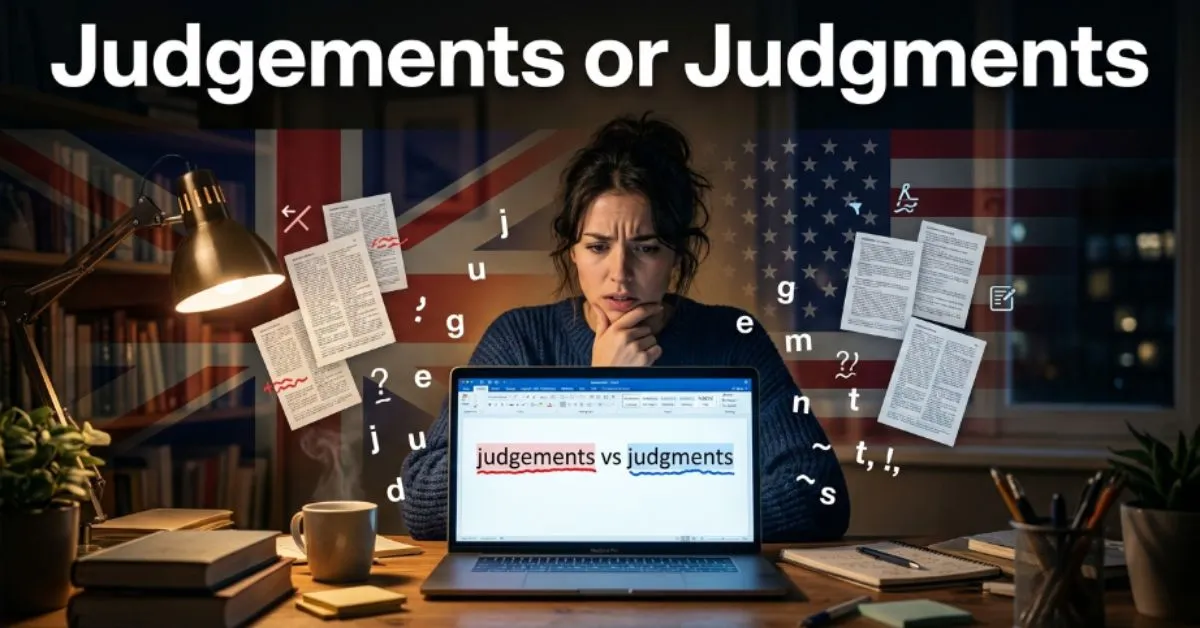
I still remember proofreading an important article late at night when I noticed something strange. I had written the word “judgements” several times, but my spelling checker kept suggesting “judgments.” At first, I assumed the software was wrong. After all, I had seen both spellings used online, in books, and even in professional documents.
The more I researched, the more confusing it became. Some dictionaries listed both versions as correct. Some style guides preferred one spelling over the other. Meanwhile, websites seemed divided on which version writers should use.
That experience made me realize that many English learners, students, bloggers, and professionals face the same confusion. They often wonder whether judgments or judgements is correct, whether one spelling is American and the other British, and whether choosing the wrong version could make their writing appear unprofessional.
The key decision most people are trying to make is simple: Which spelling should you use, and when?
The good news is that the answer is much easier than most people think. In this guide, I’ll explain the difference between judgements and judgments, show where each spelling is used, and help you choose the right version with confidence.
⚡ Judgements or Judgments – Quick Answer
Both judgements and judgments are correct spellings of the same word.
The main difference is regional usage:
- Judgments is the preferred spelling in American English.
- Judgements is commonly used in British English.
- Both mean opinions, decisions, or legal rulings.
Examples
- The judge issued several judgments.
- Her judgments are usually accurate.
- The court delivered its judgements yesterday.
Simple Takeaway Rule
If you’re writing for a U.S. audience, use judgments. If you’re writing for a U.K. audience, judgements is widely accepted.
🤔 Why Do People Compare Judgements or Judgments?
People compare these spellings because they look almost identical and share the exact same meaning.
Common reasons for confusion include:
- Spell-checkers suggesting different versions
- American and British English differences
- Legal writing conventions
- Academic style guide preferences
- Online sources using both spellings
Many writers assume one spelling must be wrong.
In reality, both versions are accepted in English. The difference comes down mainly to regional preference and style guidelines.
📜 The Background Behind Both Options
What Is “Judgment”?
The word comes from the Old French word jugement, which ultimately traces back to Latin.
Over time, English developed two accepted spellings:
- Judgment
- Judgement
Historically, both forms appeared in English writing.
Why Did Two Spellings Develop?
English spelling has changed over centuries.
American English often favors shorter spellings.
Examples include:
- Color vs Colour
- Honor vs Honour
- Favor vs Favour
Similarly, American English gradually adopted judgment as the preferred spelling.
British English continued using judgement more frequently.
Today, both spellings remain correct depending on context.
📊 Key Differences at a Glance
| Feature | Judgments | Judgements |
| Main Purpose | Opinions or legal decisions | Opinions or legal decisions |
| Meaning | Same | Same |
| Spelling Style | American English | British English |
| Pronunciation | Same | Same |
| Legal Usage | Common in USA | Common in UK |
| Availability | Widely accepted | Widely accepted |
| Convenience | Preferred in U.S. writing | Preferred in U.K. writing |
| Best For | American audience | British audience |
| Pros | Matches U.S. standards | Matches U.K. standards |
| Cons | May look unusual to some UK readers | May look unusual to some U.S. readers |
🔍 Feature by Feature Comparison
Meaning
There is absolutely no difference in meaning.
Both words refer to:
- Opinions
- Decisions
- Evaluations
- Court rulings
Pronunciation
The pronunciation is identical.
Whether you write judgments or judgements, you say the word the same way.
American English Usage
In the United States, judgments is strongly preferred.
Most American newspapers, schools, businesses, and publishers use this spelling.
British English Usage
In the United Kingdom, judgements appears more frequently.
However, some British legal documents still use judgment in certain contexts.
Professional Writing
Consistency matters more than the spelling itself.
Choose one style and use it throughout your document.
Search Visibility
Both spellings are commonly searched online.
However, American audiences generally search for judgments more often.
💰 Pricing and Value Comparison
Since these are spelling variations rather than products, there is no financial cost.
However, there is communication value.
Judgments Value
- Matches American expectations
- Preferred by many U.S. publishers
- Common in business writing
Judgements Value
- Familiar to British readers
- Fits U.K. English conventions
- Common in British publications
Which Offers Better Value?
Neither spelling is inherently better.
The best value comes from matching your audience’s expectations.
Pros and Cons ✅❌
Judgments Pros
- Preferred in American English
- Common in U.S. publishing
- Widely accepted professionally
- Recommended for American audiences
Judgments Cons
- May appear unusual to some British readers
- Less common in certain UK publications
Judgements Pros
- Traditional British spelling
- Common in UK publications
- Familiar to British readers
Judgements Cons
- Less common in American writing
- Often flagged by U.S. spell-checkers
🎯 Who Should Choose Judgments?
Use judgments if you:
- ✔ Write for American readers
- ✔ Publish U.S.-focused content
- ✔ Follow American style guides
- ✔ Work in American business settings
- ✔ Create content targeting U.S. search traffic
Best Scenarios
- U.S. blogs
- American universities
- U.S. businesses
- American legal discussions
🎯 Who Should Choose Judgements?
Use judgements if you:
- ✔ Write for British readers
- ✔ Follow British English conventions
- ✔ Publish in UK-based publications
- ✔ Create content aimed at a British audience
- ✔ Follow UK editorial standards
Best Scenarios
- UK newspapers
- British universities
- UK blogs
- British professional writing
❌ Common Mistakes People Make
Mistake #1: Assuming One Is Wrong
Reality:
Both spellings are correct.
Mistake #2: Mixing Both Spellings
Wrong:
Using judgments in one paragraph and judgements in another.
Better:
Choose one style and stay consistent.
Mistake #3: Ignoring Audience
A U.S. audience usually expects judgments.
A UK audience may expect judgements.
Mistake #4: Trusting Every Spell Checker
Different tools follow different language settings.
Mistake #5: Overthinking the Difference
The meaning never changes.
Only the spelling varies.
📝 Real Life Examples
Everyday Situations
- We make judgments every day about what to eat.
- People form judgements based on experience.
Social Media
Users often debate spelling differences between American and British English.
Reviews
Customers make judgments about products before purchasing.
Professional Discussions
Managers make judgments when evaluating employee performance.
Consumer Decisions
People use judgments when comparing products, services, and brands.
🤔 Things to Consider Before Choosing
Budget
No cost difference exists.
Long-Term Value
Choose the spelling your audience expects.
Ease of Use
Both are easy once you know the regional difference.
Personal Goals
Ask yourself:
- Am I writing for Americans?
- Am I writing for British readers?
Features Needed
Consider:
- Audience location
- Style guide requirements
- Publishing standards
Important Deciding Factor
The most important factor is audience preference.
📋 Quick Comparison Table
| Category | Winner |
| American English | Judgments |
| British English | Judgements |
| Pronunciation | Tie |
| Meaning | Tie |
| Ease of Understanding | Tie |
| Best for Beginners | Judgments |
| Best Overall Value | Depends on Audience |
| Best Convenience | Depends on Audience |
| Overall Recommendation | Match Your Readers |
FAQs ❓
Q. Is judgments or judgements correct?
Both spellings are correct.
Q. Which spelling is American?
Judgments is the preferred American spelling.
Q. Which spelling is British?
Judgements is more common in British English.
Q. Do they have different meanings?
No. Both mean exactly the same thing.
Q. Is judgment used in legal writing?
Yes. It is very common in legal contexts.
Q. Can I use judgements in the United States?
You can, but judgments is generally preferred.
Q. Which spelling should students use?
Use the version required by your school’s style guide.
Q. Why do spell checkers disagree?
Different language settings use different spelling standards.
Q. Is one more professional?
No. Professionalism depends on consistency and audience.
Q. Which spelling is more common online?
Judgments is generally more common due to American usage.
💡 Expert Tip
Before choosing between judgments and judgements, identify your audience first. If your readers are primarily in the United States, use judgments. If they’re in the United Kingdom, use judgements. Consistency is far more important than the spelling variation itself.
Conclusion
The debate over judgements or judgments is much simpler than many writers expect. Both spellings are correct, both carry the same meaning, and both have been used in English for many years.
The main difference comes down to regional preference. American English strongly favors judgments, while British English commonly uses judgements. Neither spelling is more intelligent, more formal, or more accurate than the other.
For most writers, the best approach is to consider the audience. If you’re creating content for U.S. readers, businesses, schools, or websites, judgments is usually the safest choice. If you’re writing for British readers or following UK style conventions, judgements may feel more natural.
The biggest mistake isn’t choosing one spelling over the other. It’s switching between them within the same piece of writing. Consistency creates professionalism and helps readers focus on your message rather than your spelling choices.
Once you understand the regional difference, the confusion disappears. Simply match the spelling to your audience and write with confidence.
Discover More Articles:
- Siting or Sighting : Here’s the Correct Answer👀(2026)
- Angel or Angle :The Simple Trick That Ends the Confusion Forever😇(2026)
- Plow or Plough : Don’t Make This Common Spelling Mistake🌾(2026)

I’m Franz Kafka, an author at GrammarGuides.com, where I simplify English grammar for readers. As a grammar expert, I guide you through tricky rules and common mistakes.