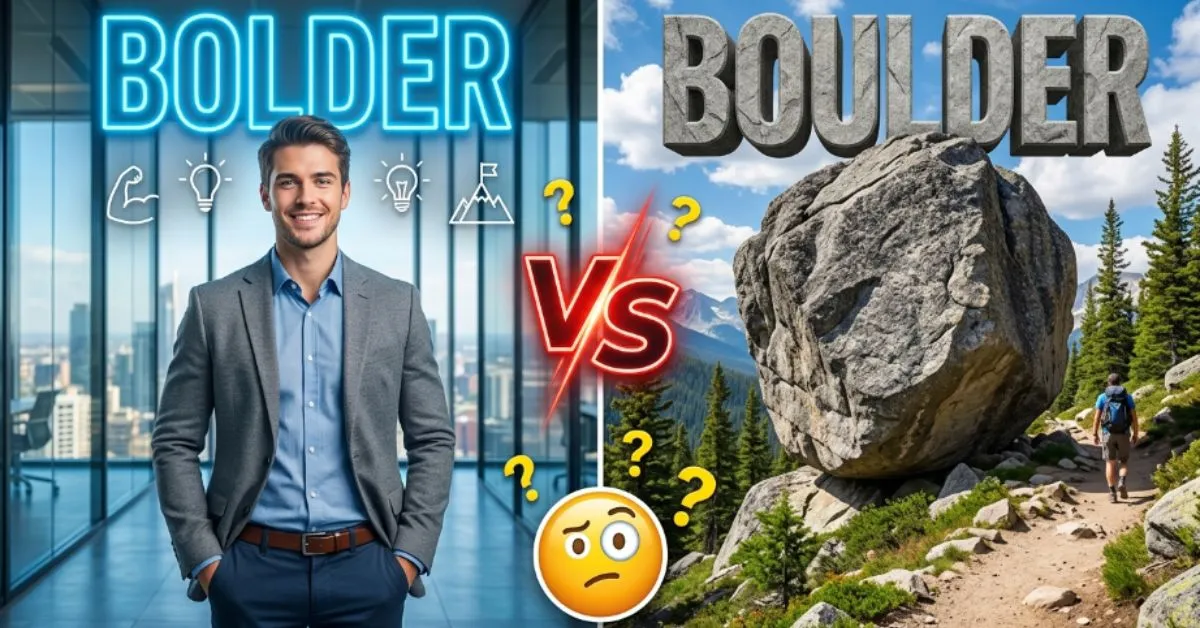
I still remember proofreading an article for a friend who loved hiking. He proudly wrote about climbing a “huge bolder” during a mountain adventure. At first, I skimmed right past it. The sentence sounded correct when I read it in my head. But then something felt off. Was it bolder or boulder?
That small spelling mistake led us into a surprisingly interesting discussion. Like many people, my friend had heard both words spoken countless times but rarely stopped to think about their meanings. Since they sound almost identical, it’s easy to mix them up.
If you’ve searched for bolder or boulder, chances are you’re facing the same confusion. Maybe you’re writing a school paper, a social media post, a travel blog, or simply trying to improve your English. The challenge is deciding which word fits your sentence.
The good news is that these words are not interchangeable. They have completely different meanings, even though they sound very similar.
In this guide, I’ll explain the simple difference between bolder and boulder, show common mistakes, provide real-world examples, and help you choose the right word with confidence every time.
⚡Bolder or Boulder – Quick Answer
Bolder is the comparative form of bold, meaning more confident, brave, or noticeable.
Boulder is a large rock or stone, usually found in nature.
Quick Examples
- She became bolder after gaining experience.
- The climber stood on a massive boulder.
- His design choice was much bolder than before.
Simple Takeaway Rule
If you’re talking about confidence or boldness, use bolder.
If you’re talking about a large rock, use boulder.
🤔 Why Do People Compare Bolder or Boulder?
People compare these words because they look and sound very similar.
Common reasons for confusion include:
- Nearly identical pronunciation
- Similar spelling
- Fast typing mistakes
- Autocorrect issues
- Limited exposure to one of the words
Many people assume bolder is just another spelling of boulder. Others mistakenly use boulder when describing a person’s behavior or style.
The reality is simple:
These words belong to completely different categories and have unrelated meanings.
📜 The Background Behind Both Options
Bolder
The word bolder comes from the adjective bold.
The word “bold” has existed in English for centuries and describes courage, confidence, or something that stands out.
Examples include:
- A bold decision
- A bold color choice
- A bold personality
When comparing two things, English often adds “-er.”
For example:
- Fast → Faster
- Strong → Stronger
- Bold → Bolder
Boulder
The word boulder comes from older terms related to large rocks and stones.
Geologists use the term to describe rocks larger than a specific size.
Today, the word commonly appears in:
- Hiking discussions
- Climbing guides
- Outdoor recreation
- Geography lessons
Despite sounding similar, the two words developed from completely different origins.
📊 Key Differences at a Glance
| Feature | Bolder | Boulder |
| Main Purpose | Comparison of boldness | Large rock |
| Part of Speech | Adjective | Noun |
| Meaning | More confident or noticeable | Large stone |
| Common Usage | Writing and speech | Nature and geology |
| Availability | Common English word | Common English word |
| Convenience | Describes qualities | Describes objects |
| Best For | Personality, design, decisions | Outdoor topics |
| Pros | Clear comparison word | Specific object description |
| Cons | Often confused with boulder | Often confused with bolder |
🔍 Feature by Feature Comparison
Meaning
This is the biggest difference.
Bolder describes a quality.
Boulder describes a physical object.
Grammar
Bolder is an adjective.
Example:
- She became bolder over time.
Boulder is a noun.
Example:
- The boulder blocked the trail.
Usage Frequency
Bolder appears frequently in:
- Business writing
- Personal development content
- Marketing copy
- Everyday conversations
Boulder appears often in:
- Travel content
- Outdoor blogs
- Geography discussions
- Hiking guides
Context
The surrounding words usually reveal the correct choice.
For example:
- His proposal was bolder.
- The boulder rolled downhill.
Reader Understanding
Using the wrong word can completely change a sentence’s meaning.
💰 Pricing and Value Comparison
Since these are words rather than products, there is no direct pricing comparison.
However, there is value in using the correct word.
Bolder
Provides value when:
- Comparing confidence
- Describing style choices
- Discussing leadership
Boulder
Provides value when:
- Describing landscapes
- Discussing geology
- Talking about outdoor activities
The better choice depends entirely on what you’re trying to communicate.
Pros and Cons ✅❌
Bolder
Pros
- Easy way to compare confidence
- Common in professional writing
- Useful in personal development topics
- Clear meaning when used correctly
Cons
- Frequently confused with boulder
- Typing mistakes are common
Boulder
Pros
- Precise geological term
- Common in outdoor writing
- Easy to visualize
- Universally understood
Cons
- Frequently misspelled as bolder
- Can create confusion in written content
Who Should Choose Bolder? 🎯
Use bolder if you are:
- ✅ Comparing confidence
- ✅ Discussing leadership
- ✅ Describing personality traits
- ✅ Writing marketing content
- ✅ Talking about design choices
Best Scenarios
- “She became bolder after college.”
- “This logo design is bolder than the previous version.”
Who Should Choose Boulder? 🎯
Use boulder if you are:
- ✅ Writing about nature
- ✅ Discussing hiking
- ✅ Describing landscapes
- ✅ Talking about rock climbing
- ✅ Creating travel content
Best Scenarios
- “A giant boulder sat beside the river.”
- “The trail winds around several boulders.”
❌ Common Mistakes People Make
Mistake #1: Using Bolder for Rocks
Wrong:
- We climbed onto a giant bolder.
Correct:
- We climbed onto a giant boulder.
Mistake #2: Using Boulder for Confidence
Wrong:
- She became more boulder during presentations.
Correct:
- She became more bolder during presentations.
Even better:
- She became bolder during presentations.
Mistake #3: Assuming They’re Variations of the Same Word
Reality:
They have completely different meanings.
Mistake #4: Ignoring Grammar
Remember:
- Bolder = adjective
- Boulder = noun
Mistake #5: Trusting Sound Alone
These words sound similar but mean very different things.
📝 Real Life Examples
Everyday Situations
- My daughter has become much bolder this year.
- A large boulder blocked the road.
Social Media
- “Taking a bolder approach to my goals this year.”
- “Found this incredible boulder while hiking!”
Reviews
- “The updated design feels bolder and more modern.”
- “The trail features massive boulders and scenic views.”
Professional Discussions
Marketing teams often discuss bolder branding.
Geologists often discuss boulder formations.
Consumer Decisions
People compare:
- Bolder design choices
- Boulder climbing destinations
The correct word depends entirely on context.
🤔 Things to Consider Before Choosing
Budget
Not applicable to word choice.
Long Term Value
Using the correct spelling improves credibility.
Ease of Use
Ask yourself:
Am I describing confidence or a rock?
Personal Goals
Clear communication should always be the goal.
Features Needed
Need a comparison word?
Choose bolder.
Need a physical object?
Choose boulder.
Important Deciding Factor
Meaning matters more than pronunciation.
📋 Quick Comparison Table
| Category | Winner |
| Best for Confidence | Bolder |
| Best for Nature Topics | Boulder |
| Best for Writing | Bolder |
| Best for Geography | Boulder |
| Best for Beginners | Context Dependent |
| Most Common Mistake | Mixing the Two |
| Overall Recommendation | Use the word that matches your meaning |
FAQs❓
Q. Is bolder a real word?
Yes. It is the comparative form of bold.
Q. What does bolder mean?
More confident, brave, noticeable, or daring.
Q. What is a boulder?
A large rock or stone.
Q. Why do people confuse bolder and boulder?
Because they look and sound very similar.
Q. Is boulder a noun?
Yes.
Q. Is bolder an adjective?
Yes.
Q. Which word relates to hiking?
Boulder.
Q. Which word relates to confidence?
Bolder.
Q. Can spell check catch the mistake?
Not always, because both are valid words.
Q. How can I remember the difference?
Boulder contains the word “ould,” making it the longer word just like a large rock is bigger.
Expert Tip 💡
Use this simple memory trick:
Bolder = Bold Person
Boulder = Big Rock
If you’re describing someone’s confidence, use bolder. If you’re describing something you could climb over on a hiking trail, use boulder.
Conclusion
The confusion between bolder or boulder is extremely common because the words look and sound alike. However, their meanings are entirely different. Bolder is the comparative form of bold and describes someone or something that is more confident, daring, or noticeable. Boulder is a noun that refers to a large rock.
The easiest way to choose correctly is to focus on the context of your sentence. If you’re discussing courage, style, leadership, or confidence, use bolder. If you’re talking about nature, hiking, climbing, or geology, use boulder.
Many writing mistakes happen because people rely on pronunciation rather than meaning. Taking a moment to think about what you’re actually describing can prevent confusion and make your writing more professional.
Neither word is better than the other. Each serves a completely different purpose. The right choice depends on your message. Once you understand the distinction, you’ll never have to second guess yourself again.

I’m Veronica Roth, an author at GrammarGuides.com, where I make English easy to understand. As a grammar expert, I help readers master spelling, punctuation, and common language mistakes.