I still remember the moment I embarrassed myself while writing a simple email about fixing my jacket. Me confidently typed: “I have sewed the button back onto my coat.” At first, it sounded completely normal to me. But a few minutes later, my friend replied with a correction: “You mean sewn, not sewed.” Honestly, I was confused immediately.
I had always thought “sewed” and “sewn” meant exactly the same thing. Both came from the verb “sew,” so why would one be correct in some sentences and awkward in others? That small grammar mistake sent me into a surprisingly deep search about “sewed or sewn.” The more I researched, the more examples I found online where people mixed them up constantly.
Some websites said both were correct. Others claimed only “sewn” should be used. Then I discovered the real reason behind the confusion: “Sewed” and “sewn” are both correct, but they are used differently in grammar.
If you’ve ever struggled with whether to say:
- “I sewed a dress”
or - “The dress was sewn by hand,”
you are definitely not alone.
The good news? Once you learn one simple grammar rule, the confusion disappears quickly. In this guide, I’ll explain the real difference between sewed or sewn, why people confuse them, where the words came from, and how to use each one correctly. By the end, you’ll never mix them up again.
⚡ Sewed or Sewn – Quick Answer
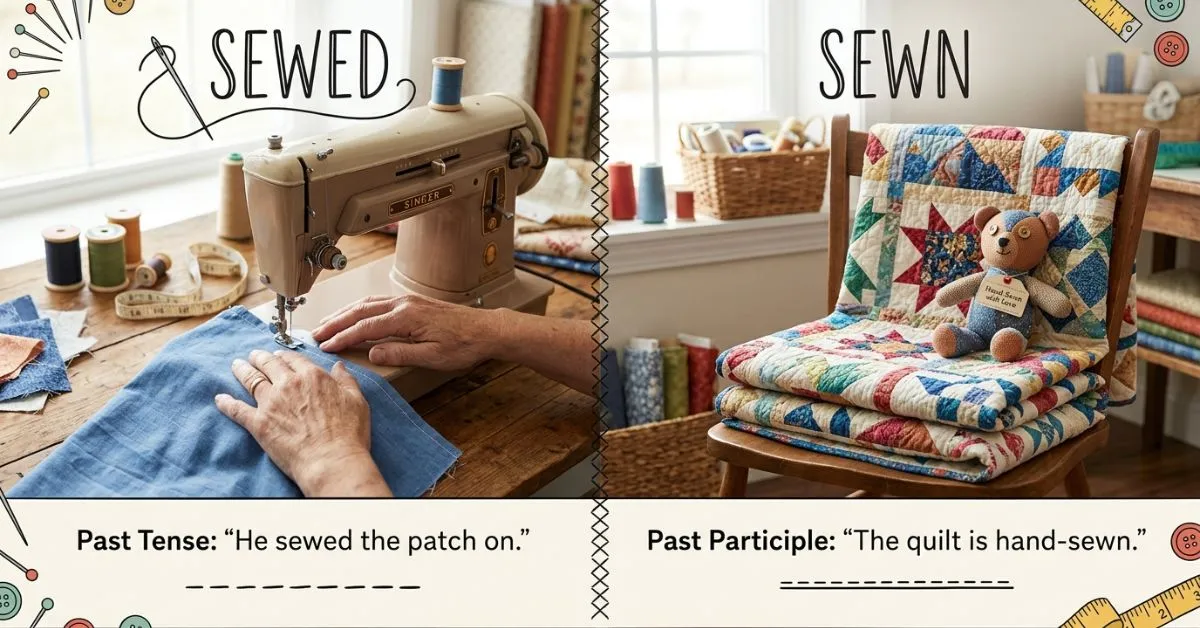
“Sewed” is the simple past tense of “sew.”
“Sewn” is the past participle usually used with:
- has,
- have,
- had,
or - was/were.
Quick Examples:
- “She sewed the costume yesterday.”
- “The costume was sewn by hand.”
- “I have sewn many shirts.”
The easiest trick:
Simple past = sewed
Perfect/passive grammar = sewn
🤔 Why Do People Confuse Sewed or Sewn?
People confuse sewed and sewn because both words come from the same verb:
- sew
Both also describe:
- stitching fabric,
- making clothes,
or - repairing material.
The confusion happens because English uses different verb forms for different grammar structures.
For example:
- “I sewed the blanket.”
sounds correct.
But:
- “I have sewed the blanket.”
sounds awkward to many native speakers.
Why?
Because English often uses:
- sewn
as the past participle form.
Another reason is pronunciation.
“Sewn” sounds unusual because it is pronounced like:
- “sohn”
Many learners expect it to rhyme directly with:
- sew
That pronunciation difference creates confusion quickly.
Irregular English verbs also make grammar harder because many verbs do not follow simple patterns.
Once you understand the difference between:
- simple past
and - past participle,
everything becomes much easier.
📜 The Origin of Sewed or Sewn
The verb “sew” comes from Old English roots connected to:
- stitching,
- joining fabric,
and - needlework.
For centuries, sewing was one of the most important household skills in many cultures.
Over time, English developed multiple verb forms:
- sew,
- sewed,
and - sewn.
The word:
- sewed
became the standard simple past tense.
Meanwhile:
- sewn
developed as the past participle form used in more advanced grammar structures.
This pattern is similar to other English verbs like:
- grow → grew → grown
- know → knew → known
- throw → threw → thrown
Unlike spelling confusion topics like “gray vs grey,” sewed and sewn are grammatical verb variations rather than regional spellings.
Today, both forms remain correct and widely used.
🌍 British vs American English
There is no major spelling difference between British and American English here.
Both regions use:
- sewed
and - sewn
However, “sewn” is often preferred in more formal writing worldwide.
| Word | American English | British English | Usage |
| Sewed | Common | Common | Simple past tense |
| Sewn | Very common | Very common | Past participle |
Examples:
- US: “She sewed the curtains.”
- UK: “The curtains were sewn beautifully.”
The grammar rules stay mostly identical.
🎯 Which One Should You Use?
Use the correct form depending on sentence structure.
Use “Sewed” When:
- describing a completed action in the past,
- using simple past tense,
or - talking about something someone did directly.
Examples:
- “My grandmother sewed my wedding dress.”
- “He sewed the patch onto his jeans.”
Use “Sewn” When:
- using has/have/had,
- writing passive voice,
or - describing completed results.
Examples:
- “The dress was sewn professionally.”
- “She has sewn hundreds of quilts.”
For Bloggers and SEO Writers
Grammar accuracy improves:
- reader trust,
- professionalism,
and - content quality.
Someone searching:
- “how to use sewn”
usually wants grammar help.
Meanwhile:
- “how to sew a shirt”
targets sewing tutorials.
Using the correct form improves:
- SEO clarity,
- readability,
and - authority.
For Freelancers and Content Creators
Correct grammar helps writing feel:
- polished,
- natural,
and - professional.
❌ Common Mistakes (Avoid These!)
Many people accidentally misuse sewed and sewn.
Mistake #1: Using “Sewed” After “Have”
❌ Wrong: “I have sewed this bag.”
✅ Correct: “I have sewn this bag.”
Mistake #2: Using “Sewn” as Simple Past
❌ Wrong: “She sewn the curtains yesterday.”
✅ Correct: “She sewed the curtains yesterday.”
Mistake #3: Forgetting Passive Voice Rules
❌ Wrong: “The shirt was sewed quickly.”
✅ Correct: “The shirt was sewn quickly.”
Mistake #4: Thinking One Form Is Incorrect
❌ Wrong: “Only sewn is correct English.”
✅ Correct: “Both forms are correct in different situations.”
Mistake #5: Confusing Pronunciation
❌ Wrong: “Sewn rhymes with fewn.”
✅ Correct: “Sewn sounds like sohn.”
📝 Real Life Examples
Here’s how sewed and sewn are used correctly in everyday writing.
Emails
“My mother sewed the costume last night.”
“The company has sewn custom uniforms for years.”
Social Media
“I finally sewed my first pillow today!”
“This jacket was sewn entirely by hand.”
News and Lifestyle Content
“Designers sewed traditional garments for the fashion show.”
“The fabrics were carefully sewn together.”
Formal Writing
“The material was sewn using industrial equipment.”
“The tailor sewed the garment with precision.”
✂️ Sewed vs Sewn: The Main Difference
Here’s the easiest way to understand the difference.
| Feature | Sewed | Sewn |
| Grammar Role | Simple past tense | Past participle |
| Example | “She sewed a dress.” | “The dress was sewn.” |
| Used With “Have” | Rare/awkward | Correct |
| Used in Passive Voice | Usually incorrect | Correct |
| Formal Writing | Common | Very common |
| Pronunciation | Sooed | Sohn |
This comparison makes the distinction much easier.
🧶 Why “Sewn” Sounds More Formal
Many native speakers feel:
- sewn
sounds more polished and professional.
Why?
Because it appears frequently in:
- books,
- formal writing,
- fashion content,
and - professional sewing instructions.
Examples:
- “Hand sewn leather”
- “Carefully sewn seams”
- “Expertly sewn garments”
Meanwhile:
- sewed
sounds more conversational because it focuses on the action itself.
Both are correct.
But grammar structure determines which one fits naturally.
🪡 Simple Trick to Remember the Difference
Here’s the easiest beginner trick.
Ask yourself:
Is this simple past tense?
Use:
- sewed
Example:
- “I sewed the button yesterday.”
Is this passive voice or perfect tense?
Use:
- sewn
Examples:
- “The button was sewn carefully.”
- “I have sewn many shirts.”
Simple rule:
Past action = sewed
Completed/passive result = sewn
📊 Quick Comparison Table
| Term | Meaning | Grammar Type | Common Usage | Region |
| Sewed | Past tense of sew | Verb tense | Past actions | Worldwide |
| Sewn | Past participle of sew | Grammar form | Passive/perfect tense | Worldwide |
FAQs❓
Q. Is it sewed or sewn?
Both are correct, but they are used differently.
Q. When should I use sewn?
Use “sewn” in passive voice or with has/have/had.
Q. Is “I have sewed” correct?
Most native speakers prefer:
“I have sewn.”
Q. Is sewn a real word?
Yes. It is the past participle of “sew.”
Q. Why does sewn sound unusual?
Its pronunciation does not match its spelling directly.
Q. Can I say “was sewed”?
Usually “was sewn” sounds more natural.
Q. Which form is more formal?
“Sewn” often sounds more formal and polished.
Q. Are sewed and sewn interchangeable?
Not completely. Grammar structure matters.
🎯 Conclusion
Understanding the difference between sewed or sewn becomes much easier once you focus on grammar structure.
“Sewed” is:
- the simple past tense,
- used for completed actions,
and - common in everyday conversation.
“Sewn” is:
- the past participle,
- used in passive voice and perfect tenses,
and - often sounds more formal.
People confuse these words because both come from:
- sew
and both describe stitching fabric or clothing. But English grammar uses them differently depending on sentence structure.
The easiest trick to remember is simple:
Simple past action = sewed
Passive or perfect tense = sewn
Once you understand that rule, the confusion disappears quickly.
The next time you write about sewing clothes, repairing fabric, or describing handmade items, you’ll instantly know which word fits correctly.
And you’ll never confuse sewed and sewn again.
Discover More Articles:
- 🐶 Chihuahua or Muffin : The Funny Viral Trend That’s Breaking the Internet
- 🐝 Bee or Wasp : The Easy Identification Trick Everyone Should Know
- Themself or Theirself : The Correct Usage Guide⚡(2026)

I’m David Mitchell, an author at GrammarGuides.com where I help readers understand English more clearly. As a grammar expert, I share simple explanations and tips to fix common spelling and grammar mistakes.