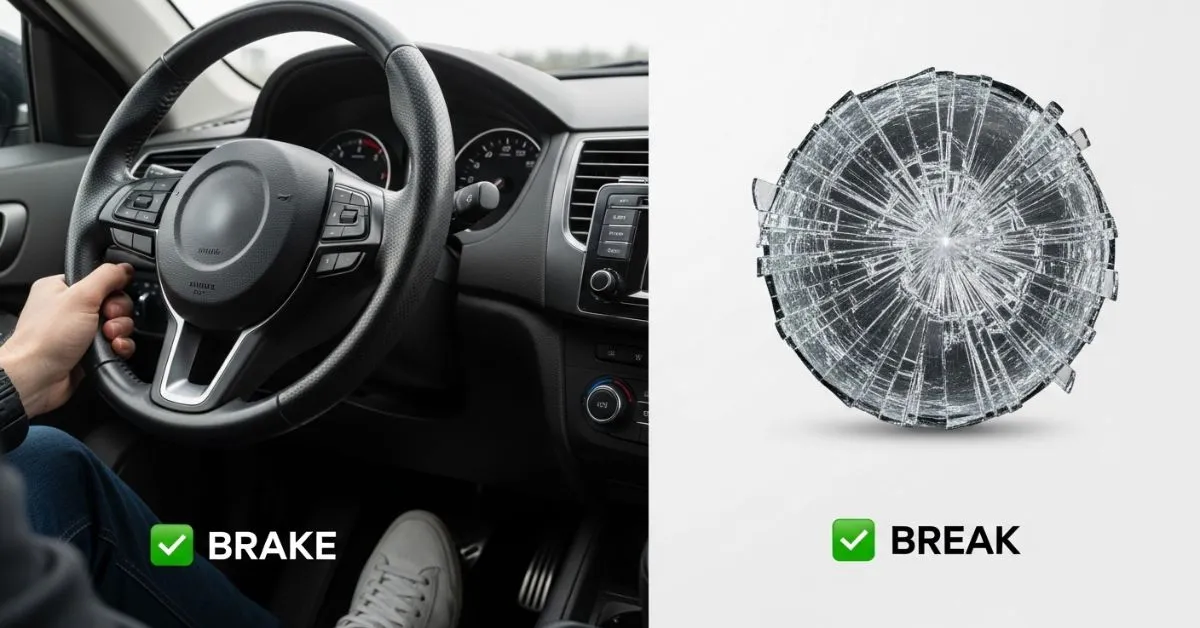
I remember typing a message once: “I need to break the car quickly.” I paused. That didn’t sound right. Was it brake or break? I had seen both words many times, and honestly, they sound exactly the same. That’s where the confusion started.
If you’ve ever searched for “brake or break”, you’re not alone. These words are called homophones. They sound the same but have different meanings. Many people mix them up in emails, social media posts, and even professional writing. One small mistake can change the meaning of your sentence completely.
This confusion is very common because English spelling is not always logical. When we hear a word, we often guess the spelling. And that’s where errors happen.
In this guide, I’ll make it very simple. You’ll learn the difference between brake or break, when to use each one, and how to remember them بسهولة. By the end, you will never mix them up again.
✅ Brake or Break – Quick Answer
Brake → ✅ Used for stopping (car, bike, motion)
Break → ✅ Used for damage, pause, or separation
👉 Examples:
- Press the brake to stop the car. ✅
- Don’t break the glass. ✅
- Let’s take a break. ✅
✔️ Simple rule:
Brake = stop | Break = damage or pause
🤔 Why This Confusion Happens
This mistake happens for a simple reason:
- Both words sound the same
- English spelling is tricky
- People write what they hear
👉 The real issue:
Brake and break are homophones.
So when you hear “brake,” your brain might think of “break.”
✔️ That’s why many people write:
❌ “Hit the break” instead of “hit the brake”
📜 The Origin of Brake or Break
These words may sound the same, but they come from different roots.
- Brake comes from an old word meaning “to stop or slow down”
- Break comes from a word meaning “to split or destroy”
Over time, both words stayed in English but kept different meanings.
👉 So even though they sound alike:
They are not related in meaning
🌍 British vs American English
Good news! There is no difference between US and UK English for these words.
| Word | British English | American English |
| brake | brake | brake |
| break | break | break |
👉 Key point:
The difference is meaning, not spelling style.
🎯 Which One Should You Use?
It depends on your sentence:
- 🇺🇸 USA audience → Use both correctly based on meaning
- 🇬🇧 UK audience → Same rule applies
- 🌎 Global writing → Follow meaning clearly
✔️ Easy guide:
- Use brake → when talking about stopping
- Use break → when talking about damage or rest
👉 Pro tip:
If it involves a car, it’s almost always brake
❌ Common Mistakes
Here are the most common errors:
❌ Wrong → ✅ Correct
- Hit the break → Hit the brake
- My car breaks failed → My car brakes failed
- Take a brake → Take a break
- Don’t brake the glass → Don’t break the glass
- I need a brake from work → I need a break from work
- He breaked the rule → He broke the rule
👉 Tip:
Check the meaning before choosing the word.
💬 Real Life Examples
📧 Emails
- “Please check the brake system before delivery.”
- “Let’s take a short break after this meeting.”
📱 Social Media
- “Time for a coffee break ☕”
- “My car brake stopped working 😬”
📰 Professional Writing
- “Brake failure caused the accident.”
- “The company decided to break the contract.”
🗣️ Daily Conversation
- “Press the brake!”
- “Don’t break it!”
💡 Pro Tips to Remember
Use these easy tricks:
- Brake = car stop (has ‘a’ like auto)
- Break = smash or rest
- Think: “Take a break, not a brake”
- If something stops → use brake
- If something breaks → use break
🔍 Comparison Table
| Word | Type | Meaning | Correct Usage |
| brake | noun/verb | to stop motion | ✅ |
| break | verb | to damage or split | ✅ |
| break | noun | rest or pause | ✅ |
| brake | noun | part of a vehicle | ✅ |
| breaked | incorrect | wrong past tense | ❌ |
FAQs❓
1. Is it “car break” or “car brake”?
It is car brake because it helps stop the car.
2. What does “break” mean?
It means to damage, split, or take a rest.
3. Are brake and break the same?
No. They sound the same but have different meanings.
4. How do I remember the difference?
Brake = stop, Break = damage or rest.
5. Is this a US vs UK issue?
No. Both use the same words and rules.
6. Can “break” mean rest?
Yes. Example: “Take a break.”
7. What is the past tense of break?
It is broke, not breaked.
🧾 Conclusion
So, what’s the final answer to brake or break?
Both words are correct, but they have very different meanings. Brake is used when talking about stopping something, especially in vehicles. Break is used when something is damaged, separated, or when you take a rest.
This confusion happens because the words sound the same, but once you understand the meaning, the choice becomes easy.
👉 Remember this simple rule:
- Brake = stop
- Break = damage or rest
There is no difference between American and British English, so you can use the same rule everywhere. If you are writing emails, blog posts, or social media captions, using the correct word will make your writing clear and professional.
Now you know the difference. The next time you write brake or break, you won’t hesitate. You’ll choose the right word with confidence.
Discover More Articles:
- Supersede or Supercede : The Right Spelling Explained Clearly✍️(2026)
- Pled or Pleaded : The Clear Difference Explained with Examples⚖️(2026)
- Glamor or Glamour : The Easy Rule Every American Should Know✨(2026)

I’m Veronica Roth, an author at GrammarGuides.com, where I make English easy to understand. As a grammar expert, I help readers master spelling, punctuation, and common language mistakes.