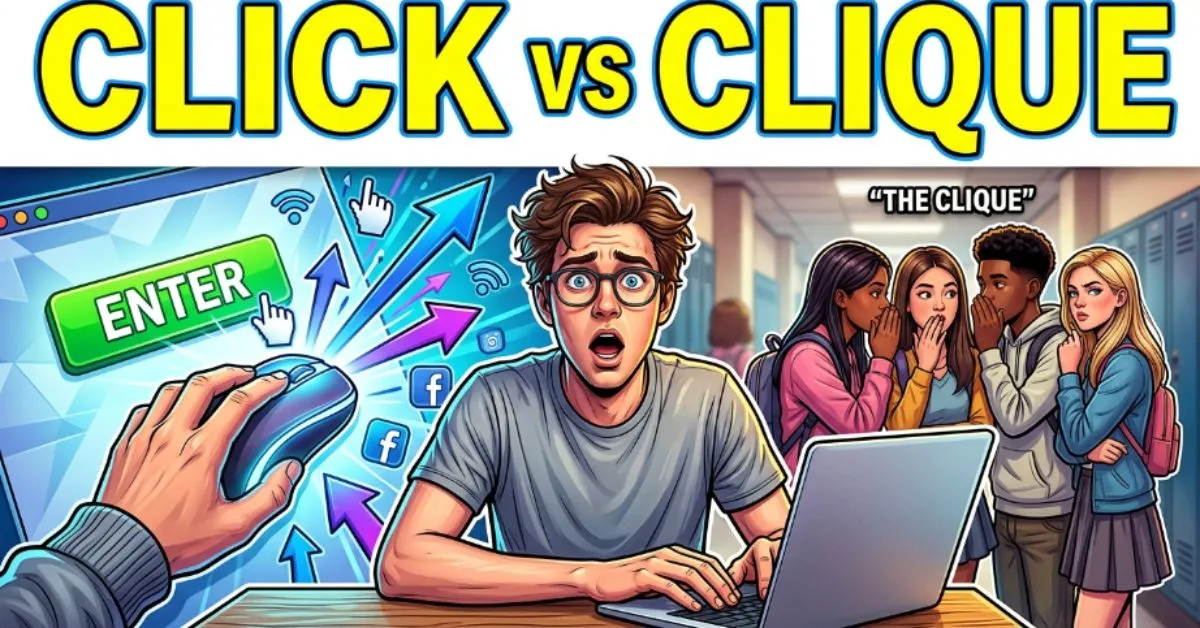
I still remember the first time I accidentally wrote “clique here” instead of “click here” while creating a small blog page. At first, I honestly thought both words were connected because they sounded almost exactly the same when spoken quickly.
But a few minutes later, someone pointed out the mistake, and I immediately felt confused. I knew “click” was related to pressing a button or opening a link, but then I started wondering:
“What does clique even mean?”
That small spelling mistake completely changed the meaning of my sentence without me realizing it.
Later, I noticed this confusion everywhere online. Some people typed “cliquebait” instead of “clickbait.” Others used “clique” when talking about websites, buttons, or social media links. Because the pronunciation sounds very similar, many English learners — and even native speakers — mix them up while typing fast.
I even remember searching online myself because I wanted to understand whether “clique” was just another spelling of “click” or a completely different word.
That’s when I discovered the truth:
These two words may sound alike, but their meanings are completely different.
If you’ve ever wondered:
“Should I use click or clique?”
you are definitely not alone. I had the exact same confusion myself.
The good news is that once I understood the meanings and how each word is used in real life, the difference became incredibly easy. In this guide, I’ll explain click vs clique in simple English so you never confuse them again.
⚡ Click or Clique – Quick Answer
“Click” usually means pressing a button, selecting something online, or instantly connecting with an idea or person.
“Clique” means a small exclusive social group that often avoids outsiders.
Quick Examples:
- ✅ “Click the link below.”
- ✅ “We instantly clicked as friends.”
- ✅ “The popular clique sat together at lunch.”
Simple Rule:
- Click = pressing or connecting
- Clique = exclusive social group
🤔 Why Do People Confuse Click or Clique?
People confuse click and clique mainly because they sound almost exactly the same when spoken aloud.
Both are pronounced very similarly:
- click
- kleek (clique)
For many English learners, the pronunciation difference feels extremely small.
Another reason is internet culture. Today, the word “click” appears everywhere:
- clickbait
- clicks
- click here
- one-click shopping
Meanwhile, “clique” often appears in:
- school dramas
- teen movies
- social discussions
- workplace conversations
The confusion becomes bigger because English contains many words with unusual spellings from French origins. “Clique” is one of them.
Some people accidentally spell:
❌ “The cool click at school”
instead of:
✅ “The cool clique at school”
Social media and texting also make spelling mistakes more common because people type quickly without checking carefully.
Another tricky detail is that “click” can also mean emotionally connecting with someone.
Example:
“We clicked immediately.”
That emotional meaning sometimes makes learners think “click” and “clique” are socially related words when they are actually very different.
Once you remember that one word is about actions and connection while the other is about social groups, the confusion becomes much easier to solve.
📜 The Origin of Click or Clique
Both words have completely different histories.
Click
The word “click” comes from sounds. Originally, it described a short sharp noise like:
- a lock clicking
- a button clicking
- a camera clicking
As technology evolved, “click” became strongly connected to computers and the internet.
Today, people use click for:
- pressing buttons
- selecting links
- connecting emotionally
- understanding quickly
Examples:
- “Click the video.”
- “Their personalities clicked.”
Clique
The word “clique” comes from French origins. It originally referred to a small group of people connected closely together.
Over time, English adopted the word to describe exclusive friend groups, especially groups that avoid outsiders.
Examples:
- school cliques
- workplace cliques
- social cliques
Today, “clique” often carries a slightly negative feeling because it suggests exclusion or social division.
🌍 British vs American English
Both British and American English use “click” and “clique” similarly.
However, “clique” is especially common in American school culture discussions and teen media.
| Word | American English | British English | Meaning |
| Click | Very common | Very common | Press/select/connect |
| Clique | Common | Common | Exclusive social group |
USA Usage
In the United States:
- “click” strongly connects with internet culture
- “clique” often appears in school or workplace discussions
Examples:
- “Click the app.”
- “The popular clique ignored everyone.”
UK Usage
In the UK, both words are understood similarly, although “friend group” may sometimes replace “clique” in casual conversation.
Overall, the meanings remain almost identical worldwide.
🎯 Which One Should You Use?
The correct word depends completely on context.
Use “Click” When:
- pressing buttons
- using websites
- talking about instant connection
- discussing online actions
Examples:
- “Click the subscribe button.”
- “We clicked immediately.”
Use “Clique” When:
- discussing social groups
- describing exclusivity
- talking about school or workplace dynamics
Examples:
- “That clique never talks to outsiders.”
- “Office cliques can create problems.”
For Bloggers and Freelancers
“Click” is extremely important in SEO and digital marketing.
Examples:
- click-through rate
- clicks
- clickbait
- clickable titles
Meanwhile, “clique” appears more in:
- psychology blogs
- social discussions
- school-related content
- entertainment writing
SEO Perspective
People often search:
- “click vs clique”
- “difference between click and clique”
- “clique meaning”
- “click meaning”
Using both keywords naturally can improve search visibility.
Best Practical Advice:
- Use click for actions and connection
- Use clique for exclusive social groups
❌ Common Mistakes (Avoid These!)
Here are the biggest mistakes people make.
Mistake #1: Misspelling Clique
❌ “The popular click at school”
✅ “The popular clique at school”
Mistake #2: Using Click for Social Groups
❌ “That friend click is exclusive.”
✅ “That friend clique is exclusive.”
Mistake #3: Forgetting Emotional Meaning of Click
❌ Thinking click only means pressing buttons
✅ Click can also mean connecting naturally
Mistake #4: Confusing Pronunciation
❌ Assuming spelling matches sound perfectly
✅ Clique has French-style spelling
Mistake #5: Using Clique Positively Everywhere
❌ “Our office clique is amazing.”
✅ Clique sometimes sounds negative or exclusive
📝 Real Life Examples
Here’s how click or clique appears in everyday life.
Emails
“Please click the attachment below.”
Social Media
“We instantly clicked after meeting online.”
“The school clique acted like celebrities.”
News Headlines
“Experts Study Social Cliques in High Schools”
“Companies Fight for More Website Clicks”
Formal Writing
“The researchers analyzed online click behavior.”
“Teen cliques may affect social development.”
📊 Quick Comparison Table
| Feature | Click | Clique |
| Main Meaning | Press/connect | Exclusive group |
| Word Type | Action noun/verb | Social noun |
| Tone | Neutral | Slightly negative |
| Internet Usage | Extremely common | Less common |
| Social Meaning | Emotional connection | Social exclusivity |
| Common Context | Technology/websites | Schools/workplaces |
| Pronunciation | Simple English sound | French-style spelling |
FAQs❓
Q. What is the difference between click and clique?
Click relates to pressing or connecting. Clique refers to an exclusive social group.
Q. Is clique pronounced like click?
Almost, but clique has a slightly longer “ee” sound.
Q. What does clique mean in school?
It means a small friend group that often excludes others.
Q. Can click mean friendship?
Yes. “We clicked” means people connected naturally.
Q. Is clique a negative word?
Sometimes. It often suggests exclusion or social division.
Q. Why do people misspell clique as click?
Because the words sound very similar in spoken English.
Q. Is click only related to computers?
No. It can also describe emotional connection or understanding.
Q. Should bloggers care about clicks?
Yes. Clicks are extremely important in SEO and online marketing.
🎯 Conclusion
Understanding click or clique becomes much easier once you focus on their core meanings.
“Click” usually relates to actions, technology, pressing buttons, or instantly connecting with someone emotionally. It is one of the most common words in modern internet culture.
“Clique,” on the other hand, describes a small exclusive social group. It often appears in school life, workplaces, social discussions, and teen culture.
The confusion happens because the words sound very similar when spoken aloud. But their meanings are completely different.
If you remember one simple rule, the difference becomes easy:
- Click = press or connect
- Clique = exclusive social group
That one tip can instantly help you avoid spelling mistakes and sound more natural in writing, social media, blogging, conversations, and everyday English communication.