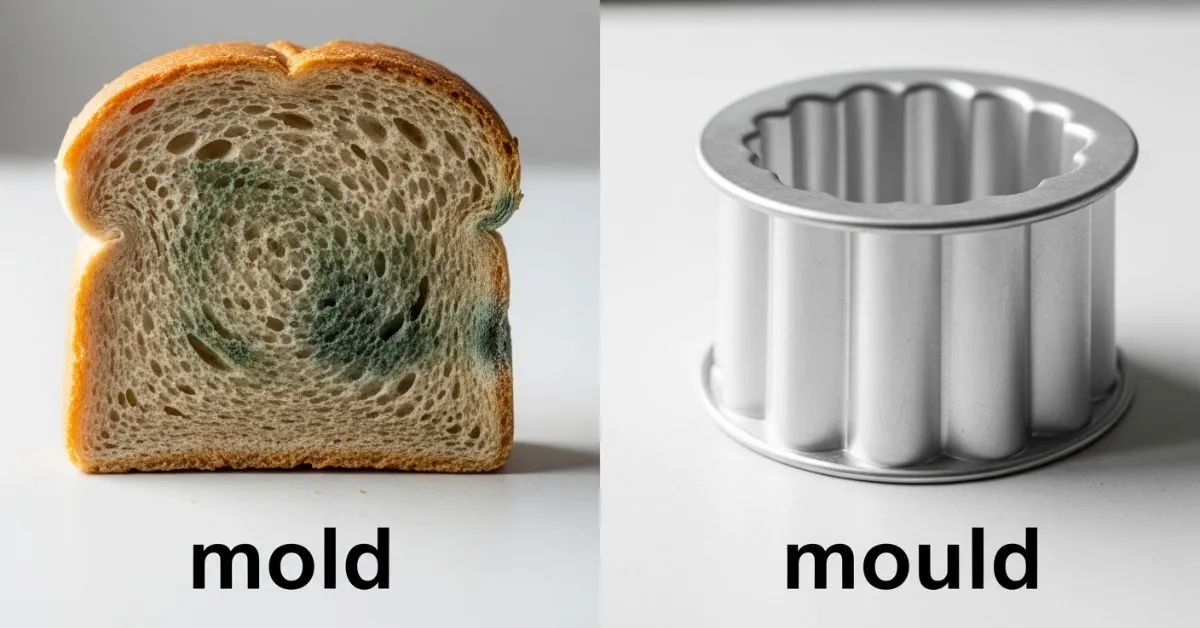
I remember cleaning a corner of my room and noticing dark spots on the wall. I typed a quick note: “There is mold on the wall.” Then I paused. Should it be mold or mould? I had seen both spellings online, and suddenly I wasn’t sure which one was right.
If you’ve ever had this confusion, you’re not alone. Many people search “mould or mold” because both spellings look correct and the truth is, they are. The confusion comes from regional spelling differences, not from right or wrong usage.
So I looked into it. I checked dictionaries, examples, and real-world usage. The answer became simple once I understood the pattern between American and British English.
In this guide, I’ll explain everything clearly so you can choose the correct spelling with confidence every time no more second guessing.
✅ Mould or Mold – Quick Answer
✅ Mold = American English 🇺🇸
✅ Mould = British English 🇬🇧
👉 Both words mean:
- A type of fungus (on food or walls)
- A shape or container used for forming objects
Examples:
- The bread has mold on it. (US)
- The bread has mould on it. (UK)
👉 Simple rule:
Use mold in the US, mould in the UK
📜 The Origin of Mould or Mold
The word comes from Old English “molde”, meaning “earth” or “soil.”
👉 Over time:
- British English kept the spelling mould
- American English simplified it to mold
This follows a common pattern:
- colour → color
- favour → favor
- mould → mold
👉 Both spellings kept the same meaning
🌍 British English vs American English Spelling
Here is the key difference:
| Version | Spelling | Notes |
| American English 🇺🇸 | mold | Shorter form |
| British English 🇬🇧 | mould | Includes “u” |
| Meaning | Same | No difference |
👉 This is a standard US vs UK spelling pattern
🎯 Which Spelling Should You Use?
🇺🇸 US audience → mold
🇬🇧 UK audience → mould
🌍 Global writing → mold (more common online)
✔ Both are correct
✔ Choose based on your audience
👉 Safe rule: Stay consistent in one style
❌ Common Mistakes with Mould or Mold
Here are frequent errors:
- ❌ Mixing mold and mould in one article
✔ Pick one style and stick to it - ❌ Thinking one spelling is wrong
✔ Both are correct - ❌ Using UK spelling for US readers
✔ Match your audience
👉 Tip:
US → shorter (mold)
UK → longer (mould)
📝 Mould or Mold in Everyday Examples
📧 Emails
There is mold in the storage area.
📰 News
Health officials warned about mold exposure.
📱 Social Media
Found mold in my fridge 😬
📚 Formal Writing
The mould growth indicates moisture damage.
📊 Mould or Mold – Google Trends & Usage Data
Search trends show:
- “Mold” → Higher usage in the United States
- “Mould” → Popular in the UK and Commonwealth
📍 Popular regions:
- United States → mold
- United Kingdom → mould
- Canada & Australia → mixed usage
- India & Pakistan → both forms used
👉 Choice depends on audience location
📋 Comparison Table – Mould vs Mold
| Feature | Mold | Mould |
| Region | US | UK |
| Correct spelling | ✅ Yes | ✅ Yes |
| Meaning | Fungus/shape | Same |
| Usage | American English | British English |
| Example | Mold on bread | Mould on bread |
FAQs❓
1. Is mould or mold correct?
👉 Both are correct. It depends on the region.
2. What is the difference between mould and mold?
👉 Only spelling differs. Meaning is the same.
3. Which spelling is used in the US?
👉 Mold is used in American English.
4. Which spelling is used in the UK?
👉 Mould is used in British English.
5. Can I use mold globally?
👉 Yes, but match your audience for best results.
6. Is mould outdated?
👉 No. It is still standard in British English.
7. Should I mix both spellings?
👉 No. Always stay consistent.
Conclusion
The confusion between mould and mold is very common, but the answer is simple. Both spellings are correct, and they have the same meaning. The only difference is where they are used.
In American English, mold is the standard spelling. In British English, mould is preferred. This follows a common pattern where American English drops the “u,” while British English keeps it.
If you remember one simple rule, it’s this:
👉 US = mold, UK = mould
The most important thing is consistency. Don’t mix both spellings in the same piece of writing. Choose one based on your audience and stick with it.
With this understanding, you can write clearly and confidently without second guessing your spelling.
Discover More Articles:
- Grimey or Grimy : Common Spelling Mistake Explained📚(2026)
- Wack or Whack : The Correct Spelling Explained Simply🤔(2026)
- Carrer or Career : Quick Guide With Easy Examples(2026)