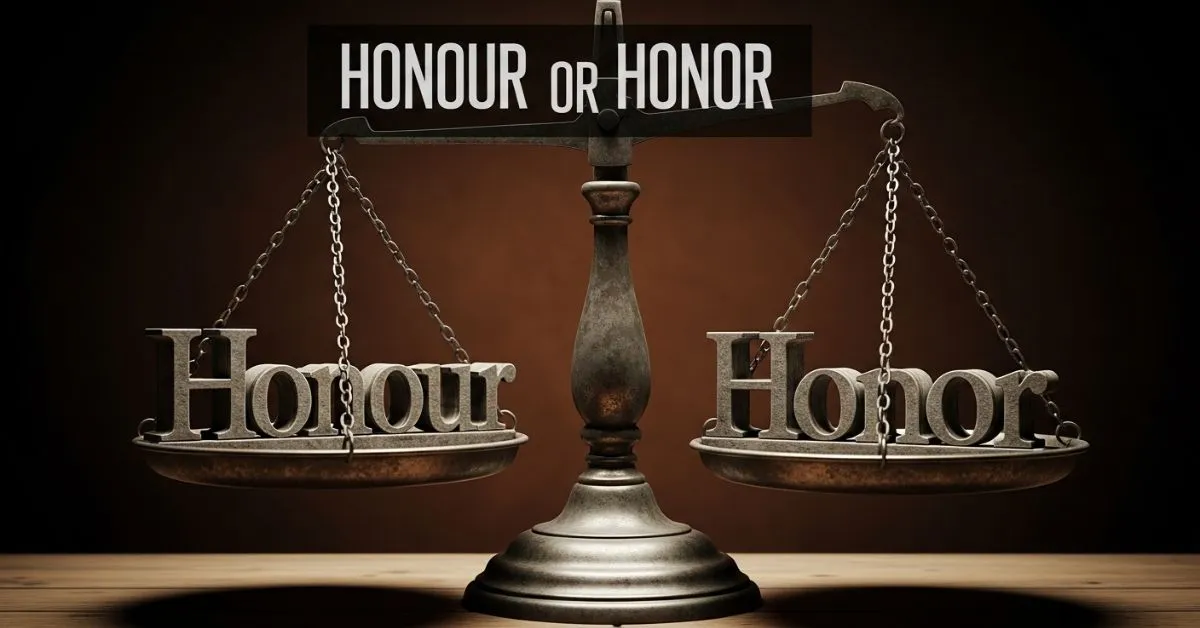
I remember writing a sentence once: “It was a great honour to receive this award.” Then I stopped. Wait… should it be honour or honor? I had seen both spellings before especially online and suddenly I wasn’t sure which one was right.
If you’ve ever had this confusion, you’re not alone. Many people search “honour or honor” because both words look correct. The tricky part? They actually are correct but not in the same place.
So I decided to figure it out. I checked dictionaries, examples, and real world usage. The answer turned out to be simple once I understood the pattern between American and British English.
In this guide, I’ll explain everything clearly so you can choose the correct spelling with confidence every time no more second guessing.
✅ Honour or Honor – Quick Answer
✅ Honor = American English 🇺🇸
✅ Honour = British English 🇬🇧
👉 Both words mean respect, pride, or recognition
Examples:
- It is an honor to meet you. (US)
- It is an honour to meet you. (UK)
👉 Simple rule:
Use honor in the US, honour in the UK
📜 The Origin of Honour or Honor
The word comes from Latin honor, meaning “respect” or “dignity.”
👉 It later moved into Old French as honour
👉 British English kept the “u”
👉 American English dropped the “u” for simpler spelling
👉 This pattern is common:
- colour → color
- favour → favor
- honour → honor
🌍 British English vs American English Spelling
Here is the key difference:
| Version | Spelling | Notes |
| American English 🇺🇸 | honor | No “u” |
| British English 🇬🇧 | honour | Includes “u” |
| Meaning | Same | No difference |
👉 This is a standard US vs UK spelling pattern
🎯 Which Spelling Should You Use?
🇺🇸 US audience → honor
🇬🇧 UK audience → honour
🌍 Global writing → honor (more common online)
✔ Both are correct
✔ Choose based on your audience
👉 Safe rule: Stay consistent in one style
❌ Common Mistakes with Honour or Honor
Here are frequent errors:
- ❌ Mixing honor and honour in one article
✔ Pick one style and stick to it - ❌ Thinking one spelling is wrong
✔ Both are correct - ❌ Using UK spelling for US audience
✔ Match your audience
👉 Tip:
Think:
US → shorter (no “u”)
UK → longer (with “u”)
📝 Honour or Honor in Everyday Examples
📧 Emails
It is an honor to work with you.
📰 News
The soldier was awarded a medal of honor.
📱 Social Media
Feeling honored to be part of this team 🙌
📚 Formal Writing
The honour of the nation must be preserved.
📊 Honour or Honor – Google Trends & Usage Data
Search trends show:
- “Honor” → Higher usage in the United States
- “Honour” → Popular in the UK and Commonwealth
📍 Popular regions:
- United States → honor
- United Kingdom → honour
- Canada & Australia → mixed usage
- India & Pakistan → both forms used
👉 Choice depends on audience location
📋 Comparison Table – Honour vs Honor
| Feature | Honor | Honour |
| Region | US | UK |
| Correct spelling | ✅ Yes | ✅ Yes |
| Meaning | Respect/dignity | Same |
| Usage | American English | British English |
| Example | Honor a hero | Honour a hero |
FAQs❓
1. Is honour or honor correct?
👉 Both are correct. It depends on the region.
2. What is the difference between honour and honor?
👉 Only spelling differs. Meaning is the same.
3. Which spelling is used in the US?
👉 Honor is used in American English.
4. Which spelling is used in the UK?
👉 Honour is used in British English.
5. Can I use honor globally?
👉 Yes, but match your audience for best results.
6. Is honour outdated?
👉 No. It is still standard in British English.
7. Should I mix both spellings?
👉 No. Always stay consistent in one style.
Conclusion
The confusion between honour and honor is very common, but the answer is simple. Both spellings are correct, and they have the same meaning. The only difference is where they are used.
In American English, honor is the standard spelling. In British English, honour is preferred. This follows a common pattern where American English drops the “u,” while British English keeps it.
If you remember one simple rule, it’s this:
👉 US = honor, UK = honour
The most important thing is consistency. Don’t mix both spellings in the same piece of writing. Choose one based on your audience and stick with it.
With this understanding, you can write clearly and confidently without second guessing your spelling.
Discover More Articles:
- Ceasar or Caesar : Read This Before You Write Again🏛️(2026)
- Dilemna or Dilemma : Here’s the Easy Rule🤯(2026)
- Tennant or Tenant : Here’s the Right Answer🏠 (2026)

I’m Franz Kafka, an author at GrammarGuides.com, where I simplify English grammar for readers. As a grammar expert, I guide you through tricky rules and common mistakes.