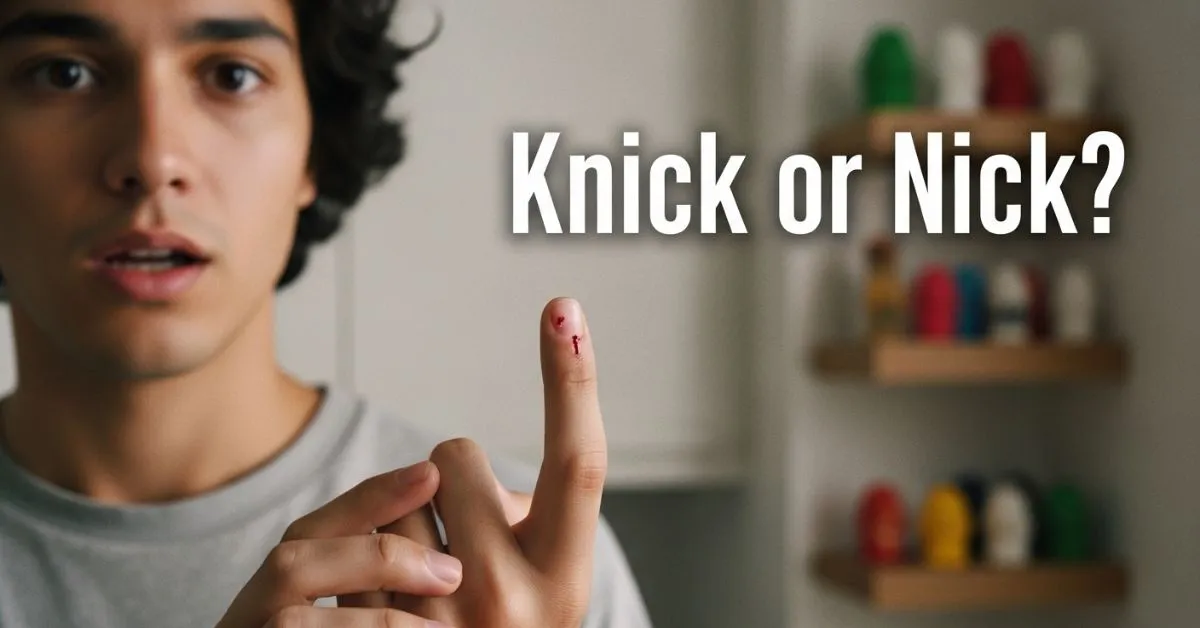
I remember writing a sentence once: “He got a small knick on his finger while cooking.” I paused and looked at it again. Something didn’t feel right. Was it knick or nick? Both words looked familiar, and I had seen them used online. That made it confusing.
If you’ve ever had this moment, you’re not alone. Many writers search for “knick or nick” because the words sound the same but don’t always mean the same thing. Sometimes it’s about a small cut, and other times it’s part of a phrase like “knick-knack.” This mix of meanings creates confusion.
The problem usually comes from pronunciation. Since both words sound alike, people often guess the spelling. But in English, spelling depends on meaning not just sound.
The good news is that the difference is simple once you understand it. In this guide, I’ll explain the correct usage, origin, and how to use each word properly in everyday and professional writing.
Knick or Nick – Quick Answer
Both words exist, but they are used in different contexts.
✅ Nick – Small cut, notch, or slight damage
✅ Knick – Rare; mostly used in “knick-knack”
Examples:
- He got a nick on his hand.
- She bought small knick-knacks for decoration.
👉 Simple rule:
Use “nick” for cuts or marks. Use “knick” only in “knick-knack.”
The Origin of Knick or Nick
The word nick comes from Old English nicor, meaning a cut or notch. Over time, it came to mean:
- A small cut
- A slight damage
- A precise moment (“in the nick of time”)
The word knick is less common. It appears mainly in the phrase “knick-knack,” which refers to small decorative objects.
Because both words sound the same, people often confuse them. But their origins and meanings are different.
British English vs American English Spelling
There is no major spelling difference between US and UK English.
| Feature | Nick | Knick |
| US English | ✅ Common | ⚠️ Rare (knick-knack) |
| UK English | ✅ Common | ⚠️ Rare (knick-knack) |
| Meaning | Cut, mark, moment | Decorative items (in phrase) |
| Professional Writing | ✅ Yes | ⚠️ Limited use |
Examples:
- US: He got a nick while shaving.
- UK: She arrived in the nick of time.
👉 Both regions use nick as the standard word.
Which Spelling Should You Use?
Choose based on meaning:
- United States: Use nick in most cases
- United Kingdom / Commonwealth: Same rule
- Global writing: Use nick
⚠️ Use knick only in:
- knick-knack (decorative items)
👉 Tip:
If you’re unsure, choose “nick.”
Common Mistakes with Knick or Nick
- ❌ Writing knick when you mean a small cut
✔ Correct: nick - ❌ Using nick in “knick-knack”
✔ Correct: knick-knack - ❌ Assuming both words are interchangeable
✔ They have different meanings
👉 Memory trick:
Nick = small cut
Knick = decoration (knick-knack)
Knick or Nick in Everyday Examples
Emails
“I noticed a small nick on the product.”
News
“The player suffered a minor nick during the game.”
Social Media
“Got a tiny nick while shaving 😅”
Formal Writing
“The surface showed a slight nick after testing.”
Knick or Nick – Google Trends & Usage Data
Search data shows clear patterns:
- Nick is widely used in all contexts
- Knick appears mainly in “knick-knack”
- High search volume comes from the US, UK, Canada, and Australia
- Many users search this keyword to understand the difference
👉 This shows nick is the dominant and standard word.
Keyword Comparison Table
| Word | Correct? | Usage |
| nick | ✅ Yes | Small cut, mark, or moment |
| knick | ⚠️ Limited | Used in “knick-knack” only |
FAQs
1. Is it knick or nick?
Both exist, but nick is more common.
2. What does nick mean?
It means a small cut, notch, or slight damage.
3. What does knick mean?
It is mostly used in “knick-knack,” meaning small decorative items.
4. Can I use knick instead of nick?
No. They are not interchangeable.
5. Is nick used in professional writing?
Yes. It is standard and widely accepted.
6. Is there a US vs UK difference?
No. Both use nick the same way.
7. What is “in the nick of time”?
It means just at the last moment.
Conclusion
The confusion between knick and nick comes from how similar they sound. Since both words are pronounced the same way, many writers assume they can be used interchangeably. However, their meanings are different, and using the wrong one can change the meaning of your sentence.
The word nick is the standard and widely used form. It refers to a small cut, a slight mark, or even a precise moment in time. You will see it in everyday writing, news articles, and professional communication. On the other hand, knick is rarely used on its own and mainly appears in the phrase “knick-knack,” which refers to small decorative items.
There is no difference between British and American English for these words, so the same rules apply everywhere. To keep your writing clear and professional, use nick in most situations. Only use knick when you are specifically referring to “knick-knacks.”
👉 Remember: Nick is common. Knick is limited.